



Pay Per Click (PPC) 03 Sep 2026
Google Ads vs Meta Ads: Where Should Your PPC Budget Go?

Written by Kalpesh Prajapati
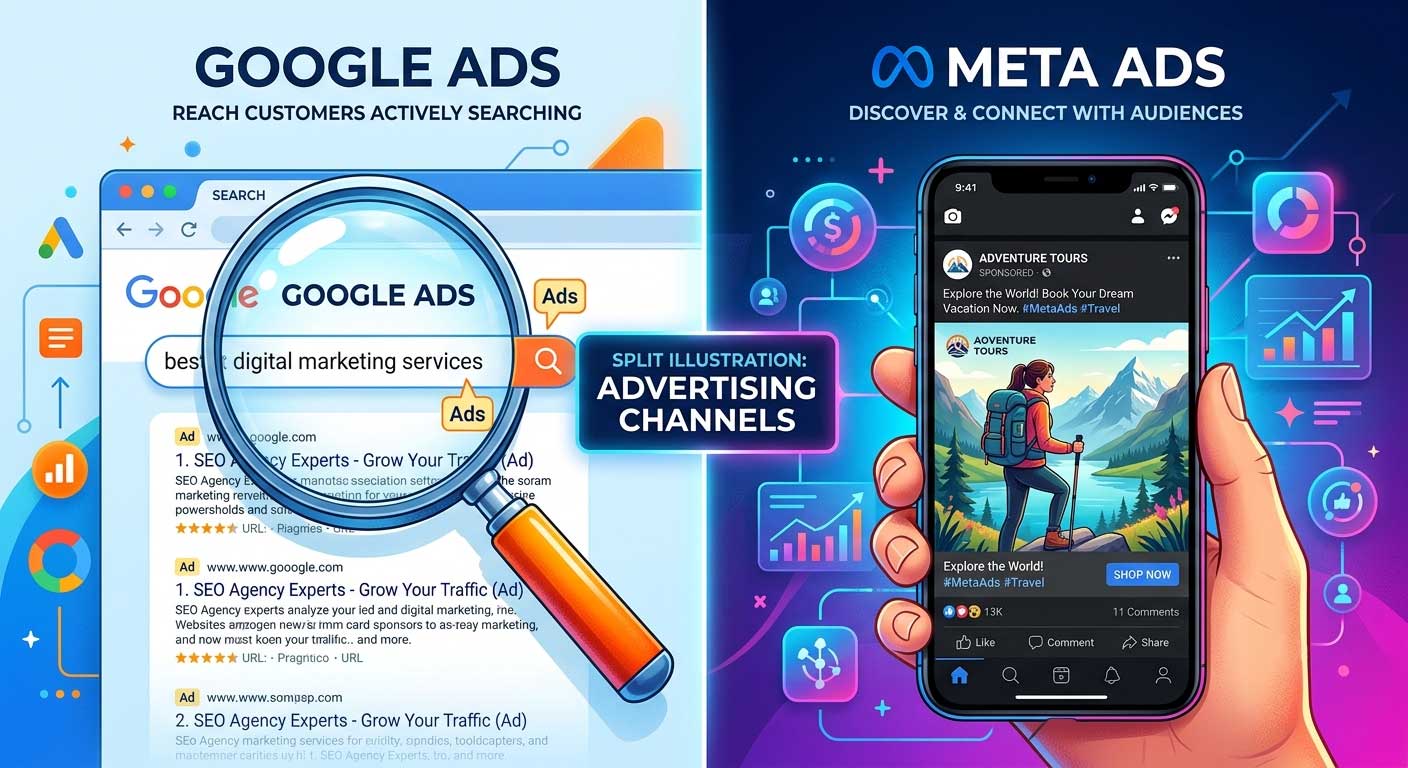
Every business with a marketing budget eventually asks the same question: Google Ads or Facebook and Instagram ads? The honest answer is that it depends on what stage your customer is at when they see the ad, and getting that wrong is one of the fastest ways to burn through an ad budget with nothing meaningful to show for it.
The Core Difference: Intent vs Discovery
Google Ads works on intent. People searching on Google are actively looking for something right now, a product, a service, a solution to a specific problem. Meta Ads works on discovery. People scrolling Facebook or Instagram aren’t actively searching for anything; they’re shown ads based on interests, behavior, and demographics, meaning the ad has to grab attention and create interest rather than simply answer a search.
When Google Ads Makes More Sense
Google Ads tends to perform better for services people actively search for, emergency or urgent needs, specific product searches, and high-intent local searches like ‘near me’ queries. Because the audience is already looking for a solution, conversions often happen faster and are easier to track directly back to ad spend.
When Meta Ads Makes More Sense
Meta Ads tends to work better for visually driven products, brand awareness campaigns, retargeting website visitors who didn’t convert the first time, and building audience interest before people start actively searching. It’s also generally more cost-effective for lower-cost, impulse-driven purchases where a compelling visual and offer can drive a quick decision.
Why Many Businesses Need Both, Not One or the Other
In practice, Meta Ads often creates demand, introducing a brand or product to someone who wasn’t looking for it, while Google Ads captures demand, catching that same person (or someone else entirely) once they start actively searching. Retargeting bridges the two: someone who saw a Meta ad, didn’t convert, then later searches on Google, is a common and valuable path. Treating these platforms as a single funnel rather than competing options usually produces better results than putting an entire budget into just one.
How to Split a Limited Budget Between the Two
For most small to mid-sized businesses, a reasonable starting split is weighted toward whichever platform matches how customers actually find the business, then adjusted based on real performance data over the first four to six weeks. The metric that matters most is cost per lead or cost per conversion, not just cost per click, since a cheaper click that never converts isn’t actually cheaper. Testing both platforms with a modest budget first, then shifting spend toward whichever is producing better-quality leads, tends to outperform guessing upfront.
Metrics That Actually Matter (and Ones That Don’t)
Click-through rate and impressions look good on a dashboard but don’t pay the bills. The metrics that actually indicate whether a PPC campaign is working are cost per lead, lead-to-customer conversion rate, and ultimately return on ad spend, how much revenue came back for every rupee or dollar spent. A campaign with a high click-through rate but a poor lead-to-customer conversion rate usually points to a mismatch between the ad’s promise and what the landing page or offer actually delivers, not a targeting problem.
It’s also worth tracking these metrics separately by platform rather than looking at combined totals. A business might see Google Ads producing fewer but higher-quality leads while Meta Ads produces more leads at a lower cost but a lower close rate. Neither is automatically wrong, but that distinction should drive how future budget gets allocated, not a single blended number that hides what’s actually happening on each platform.
Common Mistakes That Waste PPC Budget
Running ads without conversion tracking properly set up means decisions get made on guesswork instead of data, often for weeks before anyone notices. Sending all traffic to a generic homepage instead of a focused landing page built around the specific ad and offer consistently lowers conversion rates. Turning campaigns on and off inconsistently disrupts the platform’s own optimization algorithms, which need a stretch of consistent data to perform well. And ignoring negative keywords on Google Ads, terms that trigger an ad but have no real buying intent, quietly drains budget on clicks that were never going to convert in the first place.
How Long to Test Before Judging a Campaign’s Performance
One of the most common frustrations businesses run into with PPC is judging a campaign too early. Both Google Ads and Meta Ads need a learning period, typically a few weeks, where the platform’s algorithm gathers enough data to optimize targeting and bidding effectively. Pausing or drastically changing a campaign during this window resets that learning process, which often makes performance worse, not better.
A more effective approach is setting a realistic testing period upfront, generally four to six weeks for a new campaign, and evaluating performance against clear, pre-agreed metrics at the end of that window rather than reacting to day-to-day fluctuations that are often just normal variance in the platform’s optimization process.
Retargeting: The Budget Line Item Most Businesses Underuse
Retargeting campaigns, showing ads specifically to people who already visited a website but didn’t convert, consistently produce some of the strongest returns in PPC, yet many businesses allocate only a small fraction of their budget toward it. These visitors have already shown interest, which makes them meaningfully cheaper to convert than cold traffic seeing a business for the first time.
A well-structured PPC strategy usually allocates a dedicated portion of budget specifically to retargeting across both Google and Meta, rather than treating it as an afterthought layered onto a primarily cold-traffic campaign. For most businesses, this single adjustment produces a noticeable improvement in overall return on ad spend without requiring any increase in total budget.
Working With an Agency vs Managing PPC In-House
PPC platforms are accessible enough that any business can technically launch a campaign without outside help, but the learning curve for genuinely efficient campaign management is steeper than it first appears: bid strategy, audience segmentation, ad creative testing, and ongoing optimization all require consistent attention that’s easy to underestimate when juggling it alongside running the rest of a business. Businesses managing PPC in-house without dedicated time for it often end up with campaigns that were set up reasonably well but never properly optimized after launch, which quietly caps their performance well below what the budget could actually achieve.
An agency or specialist bringing pattern recognition from managing multiple accounts across industries often spots inefficiencies and opportunities faster than a business managing its own first campaign, simply from having seen similar situations play out before. This isn’t true in every case, some in-house teams manage PPC extremely well, but it’s worth being honest about how much ongoing time and expertise a campaign actually needs before assuming it can be handled as a side task.
Building a PPC Strategy That Actually Fits Your Business
There’s no universal template that works identically across every industry and budget. A local service business, a national eCommerce brand, and a B2B software company all need fundamentally different PPC approaches, different platforms weighted differently, different ad formats, different landing page strategies, and different definitions of what counts as a successful conversion. The starting point for any PPC strategy should always be the business itself: who the customer is, how they search or browse, what they need to see before they’re willing to convert, and what a realistic budget can actually achieve given the competitiveness of that specific market.
Getting this foundation right before spending a single rupee on ads is worth more than any individual tactic or platform feature, since even the best-optimized campaign will underperform if it’s built around the wrong assumptions about the audience it’s trying to reach.
A Final Word on Patience and PPC
PPC gets marketed as instant results, and to some extent that’s true, traffic starts flowing the moment a campaign goes live. But genuinely efficient, profitable PPC performance is closer to a compounding process than a switch that gets flipped on. The first few weeks establish a data baseline, the following weeks refine targeting and creative based on that data, and the strongest performance usually shows up a few months in, once the account has enough historical data for the platform’s own optimization algorithms to work at their best.
Businesses that go in expecting this trajectory, rather than judging success purely on week-one numbers, tend to build PPC campaigns that keep improving quarter over quarter instead of ones that get abandoned just as they were starting to hit their stride. Patience, paired with disciplined tracking, is what turns a PPC budget from an expense into a genuinely predictable growth channel.
How Kanopus Manages PPC for Clients
Every PPC engagement starts with the same groundwork: understanding the business, its customers, and its realistic budget before a single campaign gets built. We set up proper conversion tracking from day one, so decisions are based on actual lead and sale data rather than surface metrics like clicks or impressions. Reporting stays transparent throughout, clients always know what’s being spent, where, and what it’s producing, with adjustments made based on real performance rather than guesswork or platform sales pitches for features a specific business doesn’t actually need.
Frequently Asked Questions
It varies by industry and competition. Google Ads often has a higher cost per click but stronger intent, while Meta Ads can offer a lower cost per click but sometimes needs more nurturing to convert.
Yes, running smaller test campaigns on both platforms first can help identify where your specific audience responds better before committing a larger budget to one over the other.
Unlike SEO, PPC can drive traffic almost immediately after launch. Meaningful conversion data typically builds up within the first few weeks as campaigns get optimized based on real performance.
A dedicated landing page built around the specific ad and offer almost always converts better than sending traffic to a general homepage that isn't focused on that specific offer.
Google Ads often performs well for local service businesses due to high-intent 'near me' searches, though Meta Ads can still support brand awareness and retargeting in the same local market.