



React 12 Sep 2026
Why React Remains the Top Choice for Interactive Web Apps in 2026

Written by Kalpesh Prajapati
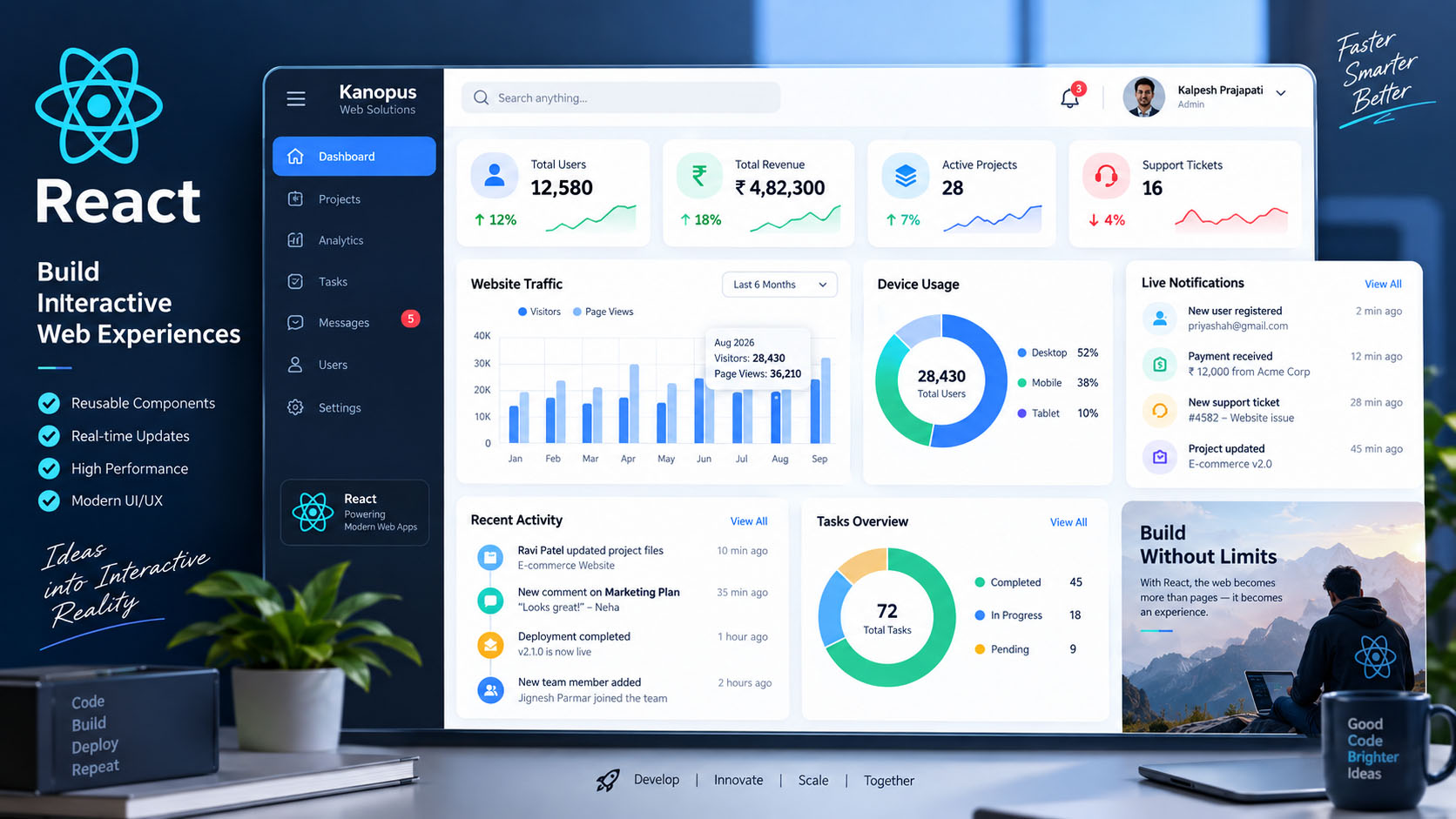
A new JavaScript framework seems to launch every few months, each promising to be faster, simpler, or more modern than what came before. And yet, when businesses need to build a genuinely interactive web application in 2026, dashboards, booking systems, SaaS products, admin panels, React still ends up as the default recommendation from most experienced development teams.
That staying power isn’t an accident, and it isn’t just inertia from older projects still running on it. React has kept its position because of a combination of factors that newer frameworks still struggle to match all at once: a mature ecosystem, a massive talent pool, and an architecture that genuinely holds up as applications grow in complexity.
If you’re evaluating frontend options for a new project, it’s worth understanding specifically why React keeps winning this comparison, and the handful of situations where a different choice might actually serve you better. This isn’t a question with a single universal answer, but the pattern across most business applications is consistent enough to be worth taking seriously before defaulting to whatever framework is trending this month.
What Makes React Different From Other Frontend Options
React is built around components, self-contained, reusable pieces of interface that manage their own logic and rendering. A button, a form, a product card, a navigation menu, each can be built once and reused throughout an application with consistent behavior. This component model isn’t unique to React anymore, most modern frameworks have adopted some version of it, but React’s implementation, backed by over a decade of refinement, remains one of the most predictable and well-documented versions of the pattern available.
The other defining feature is React’s use of a virtual representation of the interface that gets efficiently compared and updated as data changes, rather than manipulating the actual browser page directly on every update. This is part of why React applications can handle frequent, complex UI changes, live data updates, interactive forms, real-time collaboration, without becoming sluggish or unpredictable as complexity grows.
Why React Still Wins for Complex, Interactive Interfaces
Applications with a lot of moving parts, a dashboard pulling in live data from multiple sources, a booking flow with dependent form fields, a SaaS product with dozens of interactive screens, benefit specifically from React’s component architecture and mature state management options. Breaking a complex interface into smaller, independently testable components makes it realistic to build, debug, and extend an application over years without the codebase collapsing into unmanageable complexity.
This matters more as a business grows. A simple marketing site rarely stresses any framework’s limits. A product with real day-to-day usage, frequent feature additions, and multiple developers working on it simultaneously is exactly where React’s architecture, and the tooling built around it over the years, continues to prove itself against newer alternatives that haven’t been tested at the same scale for as long.
The Ecosystem Advantage: Why This Matters More Than Syntax
Comparing frameworks purely on syntax or theoretical performance benchmarks misses what actually matters for most businesses: the ecosystem surrounding a technology. React has one of the largest developer communities of any frontend technology, which means a larger pool of experienced developers to hire from, more third-party libraries and components already built and battle-tested, and faster answers when something goes wrong, since a huge share of possible issues have already been documented and solved publicly.
This ecosystem advantage compounds over the life of a project. A newer framework might offer a slightly cleaner syntax today, but a business betting its product on it is also betting on a smaller talent pool, fewer mature libraries, and less certainty about long-term support several years down the line.
Where React Isn’t Necessarily the Right Choice
React isn’t automatically the best choice for every project. A simple marketing website or a small brochure site with minimal interactivity often doesn’t need a JavaScript framework at all, and adding one can introduce unnecessary complexity and slower load times compared to a straightforward WordPress or static site. Projects with heavy SEO requirements, where content needs to be fully rendered and indexed quickly by search engines, are often better served by React paired with Next.js rather than a plain React setup, since plain React’s client-side rendering can create SEO challenges on its own.
How React Fits Into a Modern Tech Stack
In 2026, React rarely stands alone. It’s commonly paired with Next.js for projects that need strong SEO and fast initial page loads, and with a Node.js backend for applications needing real-time features or high concurrency. This combination, React or Next.js on the frontend, Node.js on the backend, has become one of the more common modern stacks specifically because all three technologies share the same language, JavaScript, which simplifies hiring, code sharing, and long-term maintenance for a development team.
For mobile needs, React Native extends the same component patterns and, in many cases, a meaningful share of the same code, into native iOS and Android apps, which is part of why businesses already invested in a React web application often extend into React Native for mobile rather than starting an entirely separate technology stack from scratch.
What Businesses Should Look For in a React Development Team
Not all React development is equal. It’s worth asking a potential development partner how they handle state management on larger applications, since poor state management decisions early in a project are one of the most common reasons React applications become difficult to maintain later. It’s also worth asking about performance practices, code splitting, lazy loading, and bundle size management, since a poorly optimized React application can end up slower than a simpler, non-framework site if these aren’t handled deliberately from the start.
How Kanopus Approaches React Projects
We start every React project by mapping out the application’s component structure and state management approach before writing significant code, since decisions made here shape how easily the application can grow later. Performance and bundle size get monitored throughout development rather than addressed only after users start complaining about slow load times. And where SEO matters to the business, we default to Next.js rather than plain React, so search visibility isn’t sacrificed for the sake of interactivity.
Planning for Growth From the Start
One of the more common mistakes in React projects is building for today’s feature list without any thought toward what the application will need to support a year or two from now. Component structure, data flow, and state management choices that feel perfectly reasonable for a small application can become genuine bottlenecks once a product grows to dozens of interconnected screens and a larger development team. This doesn’t mean over-engineering a simple project, but it does mean making a handful of deliberate architectural decisions early, decisions that are cheap to make correctly the first time and expensive to unwind later once real users and real data depend on the application working exactly as it does.
Businesses planning a React application that’s expected to grow significantly should raise this directly with their development team: what happens to this architecture at ten times the current feature count, and does the current approach still hold up. A team with genuine React experience should be able to answer that question concretely, not just reassure you that it’ll be fine.
A Realistic Look at React’s Learning Curve for Teams
React’s popularity means finding developers with React experience is easier than for many alternative frameworks, but that doesn’t mean every developer who lists React on a resume writes it the same way. The gap between someone who’s built a few small React projects and someone who’s architected and maintained a large-scale React application over years is significant, and it shows up specifically in the areas that matter most as a project grows: state management decisions, performance optimization, and how cleanly a codebase can be extended by multiple developers working on it simultaneously.
For businesses evaluating a development partner, it’s worth asking to see examples of React applications the team has built and maintained over time, not just launched once and handed off. Long-term maintenance experience reveals a lot more about a team’s actual React expertise than a portfolio of freshly launched projects alone.
Final Thoughts on Choosing React in 2026
Technology decisions are easy to overthink in an industry that produces a new framework announcement every few months. The practical reality for most businesses is simpler than the noise suggests: React remains a proven, well-supported choice for genuinely interactive applications, backed by an ecosystem and talent pool that newer alternatives haven’t yet matched. Choosing it isn’t a conservative or outdated decision, it’s usually the pragmatic one, provided it’s paired with a development team that understands how to use it well as an application grows in complexity over time.
Common Signs a React Application Needs Architectural Attention
A few warning signs tend to show up before a React application becomes genuinely difficult to maintain: adding a small feature starts taking noticeably longer than it should, the same piece of data gets managed independently in multiple places causing inconsistent behavior, and new developers take longer than expected to understand how different parts of the application connect. Catching these signs early and addressing the underlying structure, rather than continuing to build new features on top of a shaky foundation, is almost always cheaper than waiting until the problem becomes unavoidable.
Frequently Asked Questions
Yes, React remains one of the most widely used frontend technologies, backed by a mature ecosystem, a large developer community, and proven performance at scale that newer frameworks are still working to match after years in production.
Next.js is built on top of React and adds server-side rendering, routing, and performance optimizations. For projects where SEO and fast page loads matter, Next.js is generally the stronger choice; for internal tools where search visibility doesn't matter, plain React can be simpler.
Yes, using React Native, mobile apps for both Android and iOS can be built while reusing much of the same code and logic from an existing React web application, which can meaningfully reduce development time.
Simple applications can be ready in a few weeks, while complex, feature-heavy platforms may take a few months depending on integrations, state management complexity, and overall scope.
Costs depend on application complexity, design requirements, and backend integrations needed. Contact Kanopus Web Solutions for a quote tailored to your specific project.