

Contact Us +91 79925 99257



Written by Kalpesh Prajapati
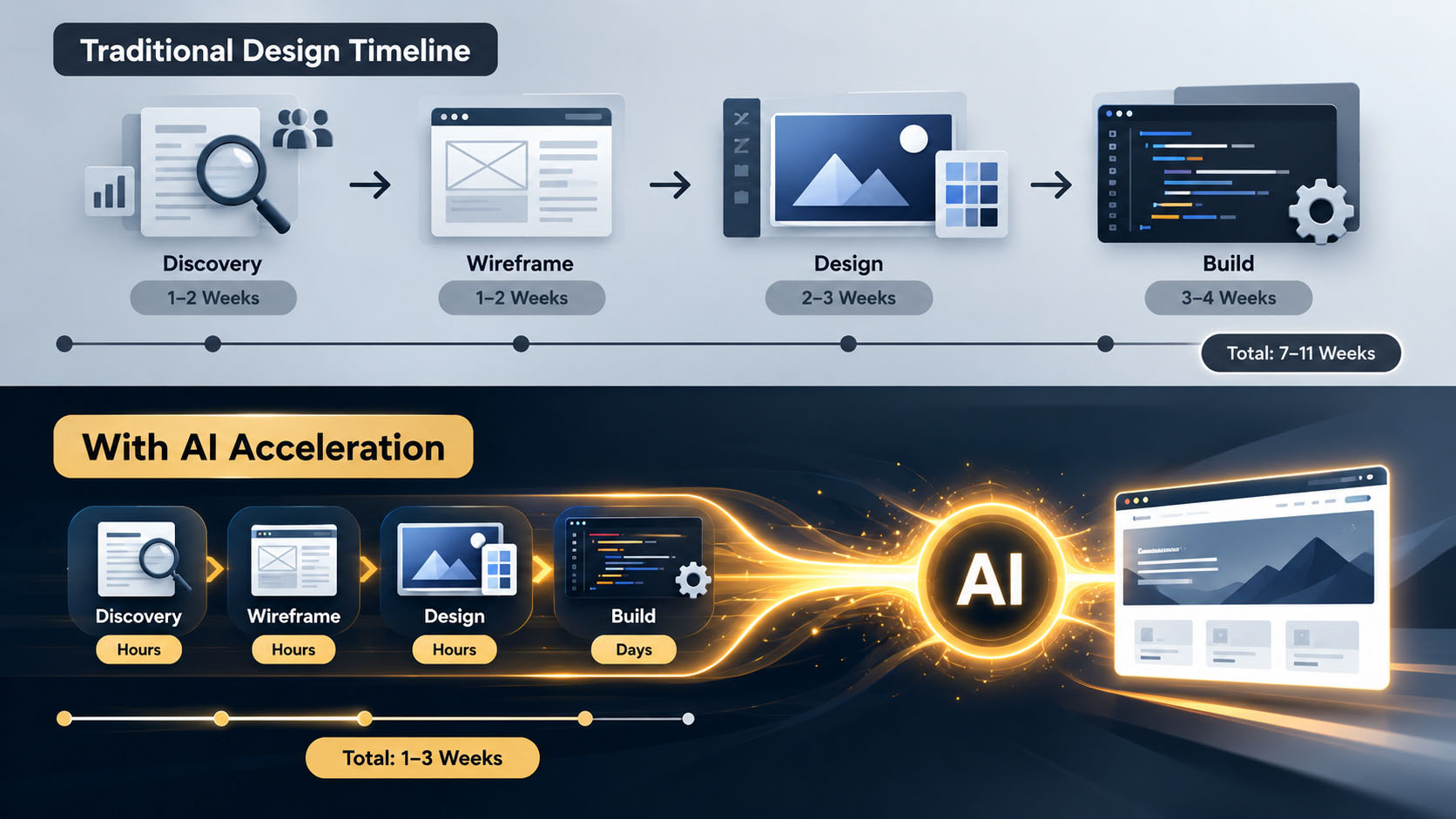
Building a website used to follow a fairly predictable, and fairly slow, sequence: discovery, wireframes, design mockups, development, testing, launch, with each stage waiting on the one before it. In 2026, AI tools have compressed several of these stages significantly, generating layout options, drafting content, and even writing basic code from a description in a fraction of the time it used to take.
This has genuinely changed how websites get built. It hasn’t changed what makes a website actually work for the business it belongs to, and understanding that distinction matters a lot for anyone planning a website project this year.
The businesses getting the most value from this shift are treating AI as a tool that speeds up production, not a replacement for the judgment that makes a website actually succeed for the business behind it.
AI tools now generate layout suggestions based on a content brief or reference examples, produce first-draft copy for pages before a writer refines it, create placeholder or even final-use imagery without needing a stock photo library, and suggest color palettes and typography pairings based on a brand’s existing assets. What used to be a back-and-forth process spanning days between a client and a designer can now start with a much stronger, faster first draft to react to and refine.
On the development side, AI coding assistants help developers write boilerplate code faster, catch syntax errors and suggest fixes in real time, and even generate first-pass implementations of common features based on a plain-language description. This speeds up the more repetitive, well-understood parts of development significantly, freeing up more time for the custom logic, integrations, and edge cases that actually require a developer’s judgment and experience.
AI-generated designs tend to converge toward familiar patterns, since they’re trained on huge volumes of existing websites, which means an unedited AI-first design often looks clean but forgettable, lacking the specific choices that make a brand feel distinct rather than templated. A designer who understands a business’s actual customers and competitive positioning still makes decisions AI can’t reliably replicate: which layout genuinely serves this specific audience, which visual choices build trust for this particular industry, and how to make a site feel unmistakably like this brand rather than a well-executed generic example.
On the development side, AI-suggested code doesn’t reliably account for security best practices specific to a project’s context, doesn’t understand a business’s full technical environment and constraints, and can introduce subtle bugs or vulnerabilities that only an experienced developer reviewing the code closely will catch before launch.
In practice, the benefit shows up mostly in timeline and iteration speed rather than a fundamentally different end product. Clients see design directions faster, get more options to react to during the discovery phase, and often see a working prototype sooner in the process than they would have a few years ago. This faster iteration cycle means more of the project timeline can go toward refining based on real feedback, rather than waiting on the first draft to even exist.
The businesses that run into trouble are the ones treating AI-generated output as a finished product rather than a starting point. A website assembled quickly from AI suggestions with minimal human review often ends up looking like countless other AI-assisted sites, technically functional, visually clean, but indistinguishable from competitors using the same tools. Security review is an even bigger risk area: skipping a proper human review of AI-suggested code before launch can leave a site carrying vulnerabilities that won’t surface until something goes wrong.
It’s worth asking directly how a potential agency uses AI in their process: which stages it speeds up, and who reviews the output before it goes live. An agency that can clearly explain this balance, using AI to accelerate the repetitive early stages while keeping designers and developers in charge of the decisions that actually differentiate the final result, is generally a stronger sign of a properly run process than one that either avoids AI entirely or leans on it without meaningful human review.
We use AI tools to speed up early drafts, layout options, first-pass copy, and routine development tasks, but every design decision that shapes how a brand actually presents itself, and every line of code that goes into a client’s live site, gets reviewed and refined by our team before launch. The goal is always the same: move faster on the parts of the process that genuinely benefit from speed, without cutting corners on the parts that determine whether a website actually works for the business it was built for.
Clients working with an agency that uses AI thoughtfully should expect a genuinely different project rhythm than a few years ago: faster initial concepts to react to, quicker turnaround on revisions since first drafts start from a stronger baseline, and more time available for the rounds of feedback and refinement that actually shape a site into something distinct, rather than most of the timeline being consumed by simply producing a first version to look at. This shift benefits clients directly, more of the project’s total time goes toward decisions that matter, rather than production time that AI can now genuinely compress.
It’s worth setting this expectation explicitly with a development partner at the start of a project: how much faster should the first draft arrive, and what will that extra time be used for instead. A team using AI well should have a clear, specific answer, not just a vague promise of being faster overall.
Beyond asking how AI fits into their process, it’s worth asking a potential partner to walk through a recent project end to end: what AI tools were used at which stages, what changed after human review, and what the client’s role was in shaping the final result versus simply approving an AI-generated first draft. Agencies confident in their process should be able to walk through this openly and specifically. Vague or evasive answers to these questions are often a sign that AI is being used to cut corners rather than to genuinely improve the process for the client.
The businesses and agencies thriving in this environment aren’t the ones resisting AI tools out of principle, nor the ones leaning on them entirely to cut cost and turnaround time regardless of quality. They’re the ones that figured out, deliberately and specifically, which parts of a website project genuinely benefit from AI’s speed, and which parts still need the judgment, taste, and accountability that only comes from an experienced person actually thinking through the problem in front of them. That balance, more than any single tool or technique, is what separates a website that merely exists from one that actually works for the business behind it.
Whether working with an internal team or an outside agency, it’s worth having an explicit conversation about where AI fits into a website project before work begins: which stages will use it, who reviews the output, and what happens if an AI-generated suggestion doesn’t fit the brand. Teams that skip this conversation often end up with inconsistent quality across a project, some sections clearly reviewed carefully, others left closer to raw AI output, simply because no one agreed on a consistent standard from the start.
The pace of change in AI tooling makes it tempting to assume today’s best practices will look outdated within a year. Some specifics will change, but the underlying principle is likely to hold steady for a while yet: AI compresses production time on well-defined, repetitive tasks, while human judgment remains essential for anything requiring genuine understanding of a specific business and its customers. Businesses planning a website project can make good decisions today by focusing on that principle rather than chasing whichever AI tool is generating the most attention this particular month.
There’s a version of web development where AI becomes an excuse to lower the bar, ship faster, review less, care less about the details that separate a genuinely good website from an adequate one. And there’s a version where AI raises the bar, freeing up time previously spent on repetitive production work to invest more deeply in the details that actually matter. Which version a business ends up with depends entirely on the team building it, not on the tools themselves.
Even with AI compressing early production stages, a genuinely good website still takes real time to plan, design, build, test, and refine properly. Businesses should be wary of promises of extremely compressed timelines that sound too good to be true, since cutting corners on review and refinement to hit an aggressive AI-assisted timeline tends to produce exactly the generic, under-tested results this article has been warning against.
Whichever platform ultimately wins out, it’s worth documenting the reasoning behind the decision, catalog size, technical resources, content strategy, so future team members or partners understand why the store is built the way it is. This small step saves real confusion down the line when someone new joins the business and wonders why the store works the way it does.
It can reduce time spent on early drafts and first-pass work, which can moderately reduce overall cost, but the price of a website still depends primarily on custom design, development complexity, and the amount of human refinement needed.
Not if the agency treats AI output as a starting point rather than a finished product. A design or development team that reviews and customizes AI-generated suggestions will still produce a distinct, brand-specific result.
Not without human review. AI-generated code and design can carry security gaps and generic patterns that a proper human review process is needed to catch before launch.
Ask specifically which parts of their process use AI and who reviews the output before it's delivered. A clear, specific answer is a good sign; vague or defensive answers are worth probing further.
We use AI to speed up early drafts, layout options, and routine development tasks, while every design decision and line of code is reviewed and refined by our team before anything goes live.
Whether you’re planning a new website or a redesign, Kanopus Web Solutions can show you exactly how we use AI to move faster without cutting corners on quality, with a clear explanation of what’s AI-assisted and what’s hand-reviewed at every stage. Call +91 79925 99257 or email info@kanopuswebsolutions.com.