



Contact Us +91 79925 99257


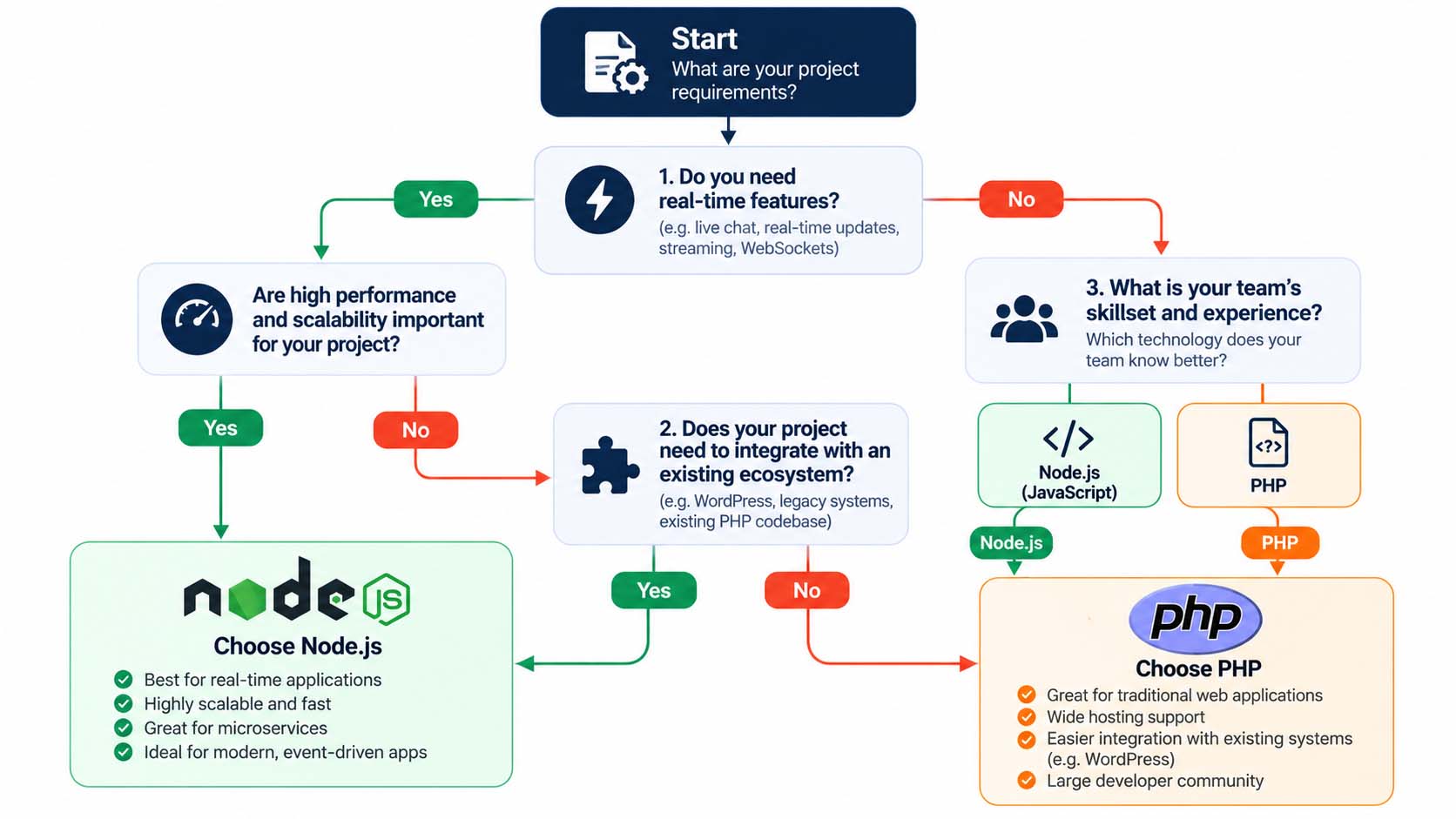
Choosing a backend technology is one of the earliest, and most consequential, decisions in any custom web application project. Node.js and PHP both remain genuinely popular, well-supported choices in 2026, but they’re built on different philosophies and tend to excel in different situations. Understanding those differences honestly, rather than defaulting to whichever technology a specific developer happens to prefer, leads to a much better long-term outcome for the business footing the bill. This decision shapes development speed, hiring, and maintenance for years, so it deserves more scrutiny than it usually gets.
PHP was built specifically for the web, processing one request at a time in a straightforward, predictable way that’s well-suited to traditional web applications: pages that load, process a request, and return a response. Node.js uses an event-driven, non-blocking architecture that excels at handling many simultaneous operations efficiently, particularly where an application needs to manage a large number of concurrent connections or real-time data. Neither approach is inherently better, they’re simply optimized for different patterns of use.
Applications with genuine real-time requirements, live chat, collaborative tools, real-time dashboards, live notifications, benefit significantly from Node.js’s event-driven architecture and native support for technologies like WebSockets. Node.js also allows a team to use JavaScript across both frontend and backend, which can simplify development, code sharing, and hiring for businesses already building their frontend in React or a similar JavaScript framework.
For traditional web applications, content-driven sites, standard business logic, CRUD-heavy admin systems, PHP, especially paired with a modern framework like Laravel, remains a proven, efficient, well-supported choice. PHP’s massive existing ecosystem, including WordPress and WooCommerce, also means it’s frequently the practical choice for businesses already operating within that ecosystem, where introducing a second, different backend language adds complexity without necessarily adding proportional value.
Raw performance benchmarks often favor Node.js for high-concurrency scenarios, but for most typical business applications, the practical performance difference between a well-built Node.js application and a well-built, properly optimized PHP application is small enough that it shouldn’t be the deciding factor on its own. Poor architecture decisions in either technology will hurt performance far more than the underlying language choice itself. The more useful question isn’t which technology is faster in the abstract, it’s which one fits the specific concurrency and real-time demands of the actual application being built.
Both technologies have large, active developer communities and extensive libraries for common tasks, but the specific ecosystem fit can matter for a given project. A business planning deep WordPress or WooCommerce integration naturally leans toward PHP. A business building a modern, JavaScript-heavy frontend with React or Next.js often benefits from Node.js on the backend simply to keep the entire team working in a single language, which can meaningfully improve development speed and reduce context-switching overhead for the team.
Developer rates and availability for both technologies are broadly comparable in most markets, so cost differences tend to come down more to project architecture and complexity than the base technology choice itself. That said, a mismatch between technology and project needs, choosing Node.js for a simple content site that didn’t need real-time features, or forcing PHP to handle a genuinely high-concurrency real-time application, tends to introduce hidden costs down the line: workarounds, performance issues, or a costly technology switch mid-project.
Start with the application’s actual requirements: does it need genuine real-time functionality, and how important is matching the backend language to an existing or planned JavaScript frontend. From there, consider the surrounding ecosystem, is this extending an existing WordPress or PHP-based system, or starting fresh with modern JavaScript tooling. These practical, project-specific factors should drive the decision far more than general opinions about which technology is more modern or exciting.
Consider a logistics company building a live delivery tracking feature where customers watch their order move in real time, Node.js’s event-driven architecture is a strong, natural fit for the constant stream of location updates involved. Now consider a professional services firm building a client portal with standard document uploads, scheduling, and account management, no real-time requirements, straightforward business logic, PHP paired with Laravel handles this reliably and efficiently without needing Node.js’s specialized real-time strengths at all. Neither company made a wrong choice; each matched the technology to what their specific application actually needed to do.
Regardless of which backend a business chooses, the quality of the architecture, how data is structured, how security is handled, how the application is tested, has a far bigger impact on long-term success than the underlying language. A poorly architected Node.js application can underperform a well-built PHP application, and the reverse is equally true. Businesses should spend at least as much time vetting a development team’s architectural discipline and testing practices as they spend debating which specific technology to use for the project.
We evaluate each project against its actual technical requirements, concurrency needs, real-time features, existing systems it needs to integrate with, before recommending a backend technology. Both Node.js and PHP are capable, well-supported choices in our hands; the right answer depends entirely on what a specific project actually needs to do, not a default preference applied regardless of fit or a trend worth chasing for its own sake.
Before finalizing a backend technology choice, it’s worth asking a development team directly: what specifically about this project justifies this technology over the alternative, and what happens if the application’s real-time or concurrency needs change significantly after launch. A team that can answer this concretely, rather than defaulting to a generic preference, is giving you a technology decision grounded in your actual project rather than their own comfort zone.
Neither technology is inherently superior, and framing the decision as a competition misses the point. The genuinely useful question is always project-specific: what does this application need to do, for how many users, under what performance conditions, and which technology gets a business there with the least friction and the most room to grow afterward.
Whichever technology ends up being the right fit, we build with the same discipline: clean architecture, proper testing, and security best practices applied from the start rather than retrofitted later. That consistency in how we build matters more to a project’s long-term success than which specific language sits underneath it.
A mismatch doesn’t usually show up immediately, it tends to surface months into a project, once the application reaches a scale or a feature requirement the original technology wasn’t well-suited for. At that point, the business faces a choice between an expensive technology migration or continuing to force-fit features onto infrastructure that was never built for them, both of which cost significantly more than getting the initial decision right would have.
Technology choices age best when they’re made for reasons that remain true regardless of which framework is currently fashionable. A decision grounded in an application’s actual concurrency needs, team skillset, and ecosystem fit will still look sound in five years. A decision made because a particular technology was trending at the time rarely ages as well.
It’s tempting to default to whichever backend technology a business or its existing team already knows best, and sometimes that’s genuinely the right call. But it’s worth at least pausing to confirm that familiarity, rather than genuine technical fit, isn’t the only reason behind the choice, since a comfortable default that doesn’t actually suit a project’s requirements tends to create problems that only surface well after the decision is already locked in.
Ultimately, both Node.js and PHP are mature, capable, widely deployed technologies that power enormous amounts of the production web today. Neither choice is a gamble in the way an unproven, experimental technology would be. The real risk lies not in choosing between these two well-established options, but in choosing without a clear, honest understanding of what the specific project actually needs from its backend.
For businesses still genuinely torn between the two, building a small prototype of the application’s most demanding feature in each technology can resolve the debate faster than continued discussion alone. Real, hands-on evidence of how each option handles a project’s specific core requirement tends to settle the decision more convincingly than any general comparison ever could.
Not necessarily. Node.js tends to have an advantage for high-concurrency, real-time scenarios, but for typical business applications, good architecture matters far more than the underlying language choice.
It's a reasonable factor to consider, since it keeps the team working in a single language, but it shouldn't override genuine technical requirements if PHP is otherwise a better fit for the project.
No, modern PHP, especially with a framework like Laravel, remains a fully capable, actively maintained technology well-suited to most traditional business web applications.
Yes, some businesses run a PHP-based content platform like WordPress alongside a separate Node.js service for real-time features, integrating the two through APIs.
Costs depend more on project complexity and architecture than on the base technology, though mismatching technology to project needs can introduce hidden costs down the line that outweigh any initial savings.
Not sure whether Node.js or PHP fits your project better? Kanopus Web Solutions can review your actual requirements, your team’s existing skillset, and your growth plans, then recommend the backend that genuinely fits, not the one that’s trendiest, with clean architecture and proper testing built in from day one. Call +91 79925 99257 or email info@kanopuswebsolutions.com.