

Contact Us +91 79925 99257



Written by Kalpesh Prajapati
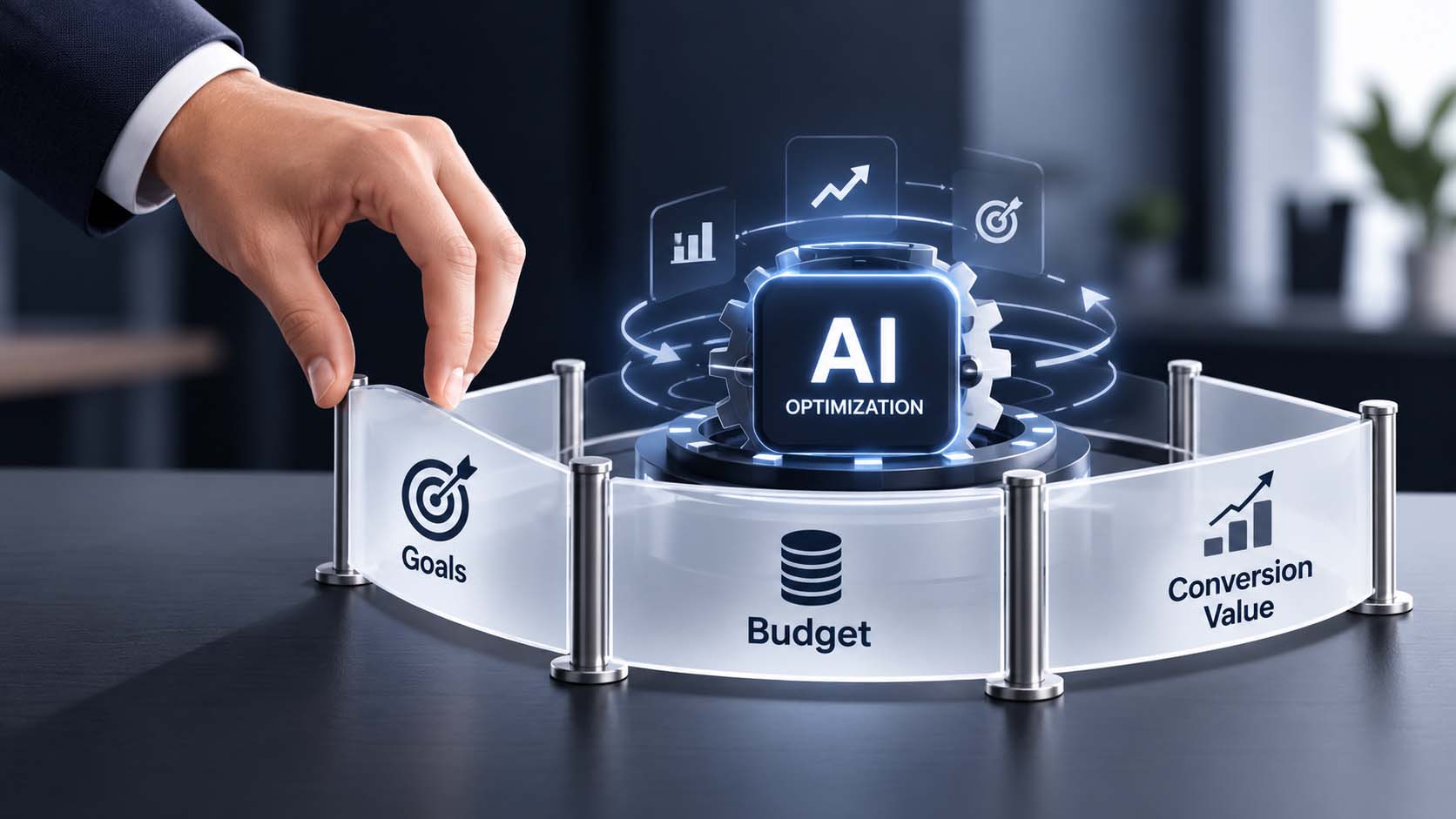
Google has pushed AI deeper into its advertising platform than almost any other part of its product ecosystem, automated bidding strategies, AI-generated ad copy, performance max campaigns that make targeting decisions with minimal manual input. For businesses running PPC campaigns in 2026, this shift has genuinely changed what day-to-day campaign management looks like, and what a skilled PPC manager’s job actually involves now. Understanding that shift is the difference between ad spend that compounds and ad spend that quietly underperforms.
AI now touches nearly every layer of the platform: automated bidding strategies that adjust bids in real time based on predicted conversion likelihood, Performance Max campaigns that use machine learning to find and target relevant audiences across Google’s entire ad network, AI-generated ad copy variations tested automatically to find top performers, and automated asset optimization that adjusts which images, headlines, and descriptions show based on performance data.
Automated bidding, when given enough historical conversion data to work with, often outperforms manual bid management, since it can factor in far more signals, device, time of day, location, user behavior patterns, than a person adjusting bids manually ever realistically could. AI-generated ad copy variations also speed up testing significantly, surfacing high-performing combinations faster than manually writing and testing each variation individually.
AI optimization works from the data it’s given, and it has no inherent understanding of a business’s actual goals, brand positioning, or which conversions genuinely matter most versus which are low-value. Left fully unsupervised, automated systems can optimize toward the wrong goal entirely, maximizing a loosely defined conversion metric rather than genuinely valuable customers, or drifting ad messaging in directions that technically perform but don’t match how a business actually wants to be represented.
Human oversight remains essential for setting the right goals and guardrails upfront, reviewing AI-generated creative for brand fit and accuracy, and recognizing when automated systems are optimizing toward a metric that looks good on a dashboard but doesn’t actually translate to real business value.
Automated bidding strategies like Target CPA or Maximize Conversions use machine learning models trained on a campaign’s historical performance to predict, in real time, how likely a specific auction is to result in a valuable conversion, then bid accordingly. This requires a meaningful amount of historical conversion data to work well, campaigns with very little data often perform poorly under automated bidding until enough signal has accumulated, which is worth understanding before switching a low-volume campaign over to full automation.
Google’s AI tools can now generate headline and description variations automatically, test them against each other, and favor the combinations that perform best. This genuinely speeds up the testing process, but AI-generated copy still benefits from human review before it goes live, both to ensure accuracy and to make sure the tone and messaging actually align with how a business wants to be represented to potential customers.
Handing a campaign over to full automation without proper setup and ongoing oversight is one of the more common mistakes businesses make as these tools become more capable and more heavily promoted by the platform itself. Conversion tracking needs to be genuinely accurate for automated bidding to optimize toward the right outcome; if it’s tracking the wrong events, or valuing all conversions equally when some are far more valuable than others, automation will faithfully optimize toward the wrong target, often without anyone noticing until results start slipping.
The practical approach for 2026 is using AI tools for what they’re genuinely good at, bid optimization at scale, rapid creative testing, pattern recognition across large data sets, while keeping a human firmly in charge of strategy: what counts as a valuable conversion, how campaigns should be structured, and whether the automated results actually align with real business goals, not just the metrics the platform is reporting.
We set up conversion tracking carefully before relying on any automated bidding strategy, ensuring the system is optimizing toward genuinely valuable outcomes, not just any conversion event. AI-generated creative gets reviewed for brand accuracy before going live, and we monitor automated campaigns regularly rather than assuming they’ll keep performing well without any oversight once set up.
Performance Max campaigns represent one of the more significant shifts in how Google Ads works, handing much of the targeting and placement decision-making to Google’s machine learning models across Search, Display, YouTube, and other properties simultaneously. This can produce strong results, particularly for businesses with clean, abundant conversion data, but it also means less granular visibility into exactly where and how a campaign is performing compared to traditional, manually segmented campaigns. Businesses using Performance Max should set clear conversion value rules upfront and monitor overall results closely, even though day-to-day control feels more limited than with traditional campaign types.
The most effective approach to AI-assisted PPC treats automation and human strategy as a continuous feedback loop rather than a one-time handoff. AI tools surface patterns and optimize execution at a scale no person could match manually, while a human reviews results regularly, questions anything that looks off, and adjusts the underlying strategy, goals, budget allocation, conversion definitions, based on what the data is actually showing. This loop, run consistently, tends to outperform either pure automation or pure manual management on their own.
Google’s AI tools are powerful, genuinely capable of improving campaign performance at a scale manual management can’t match. But power without proper direction tends to optimize efficiently toward the wrong target. The businesses winning with AI-assisted PPC in 2026 are the ones that set that direction carefully, then let the automation do what it does best.
Businesses adopting more AI-driven campaign types should watch a few specific signals closely: whether conversion volume and quality are trending in the right direction together, not just volume alone, whether cost per acquisition stays within an acceptable range as automation takes on more decisions, and whether ad messaging generated or selected by AI still feels consistent with the brand across every variation being tested.
The campaigns that perform best in 2026 aren’t the most automated or the most manually managed, they’re the ones where automation and human judgment are each doing the job they’re genuinely best suited for, with someone paying close enough attention to notice when that balance needs adjusting.
If it’s been a while since anyone reviewed how automated your current Google Ads campaigns actually are, a good starting point is simply checking which bidding strategy each campaign is using, confirming conversion tracking is accurately capturing genuinely valuable actions, and reviewing a sample of AI-generated ad copy currently running for accuracy and brand fit. This quick audit alone often surfaces an immediate opportunity worth acting on.
As campaigns become more automated, it becomes even more important for a PPC manager or agency to clearly explain what the automation is actually doing and why, rather than letting “the algorithm decided” become an unquestioned black box. Clients deserve to understand the logic behind their ad spend, even when the day-to-day execution is increasingly handled by machine learning rather than manual adjustments.
Expect Google to keep pushing more decision-making into automated systems over the next few years, which makes the skill of setting up and interpreting these systems correctly more valuable, not less. The PPC managers and agencies who stay relevant are the ones treating this as a shift in what skilled management looks like, not a signal that management is no longer needed at all.
As AI takes over more of the mechanical bid and placement decisions, the valuable human skills shift toward strategy, goal definition, conversion tracking accuracy, and creative judgment. PPC professionals and agencies that invest in these higher-level skills, rather than competing with automation on tasks it now handles better, are the ones genuinely adding value to a campaign’s performance going forward.
Businesses managing PPC in-house should make sure whoever oversees campaigns understands not just how to turn on automated bidding, but how to properly set it up, interpret its results, and recognize when something looks off. This understanding is what separates a team genuinely benefiting from AI-assisted tools from one simply hoping the automation works out without really understanding what it’s doing on their behalf.
Automated bidding and AI tools can genuinely improve performance, but they need accurate conversion tracking and periodic human oversight to make sure they're optimizing toward outcomes that actually matter to your business.
Not always. Automated bidding generally needs a meaningful amount of historical conversion data to perform well, so very new or low-volume campaigns may see better results starting with manual bidding first.
AI-generated variations can perform well and speed up testing significantly, but human review before launch helps ensure accuracy and brand fit that AI doesn't reliably account for on its own.
Yes, if conversion tracking isn't set up accurately or values the wrong actions, automated systems will faithfully optimize toward that incorrect target, which is why proper setup matters as much as the technology itself.
Yes, strategy, goal-setting, conversion tracking accuracy, and creative review still require human judgment that AI tools don't provide on their own, even as the day-to-day bid management becomes increasingly automated over time.
If you’re not sure whether your Google Ads automation is actually optimizing toward the right goals, Kanopus Web Solutions can review your setup and make sure AI is working for your business, not against it, with clear reporting you can actually follow. Call +91 79925 99257 or email info@kanopuswebsolutions.com.