



Magento 09 Nov 2026
Magento vs Shopify: Which Is Better for Enterprise Stores?

Written by Kalpesh Prajapati
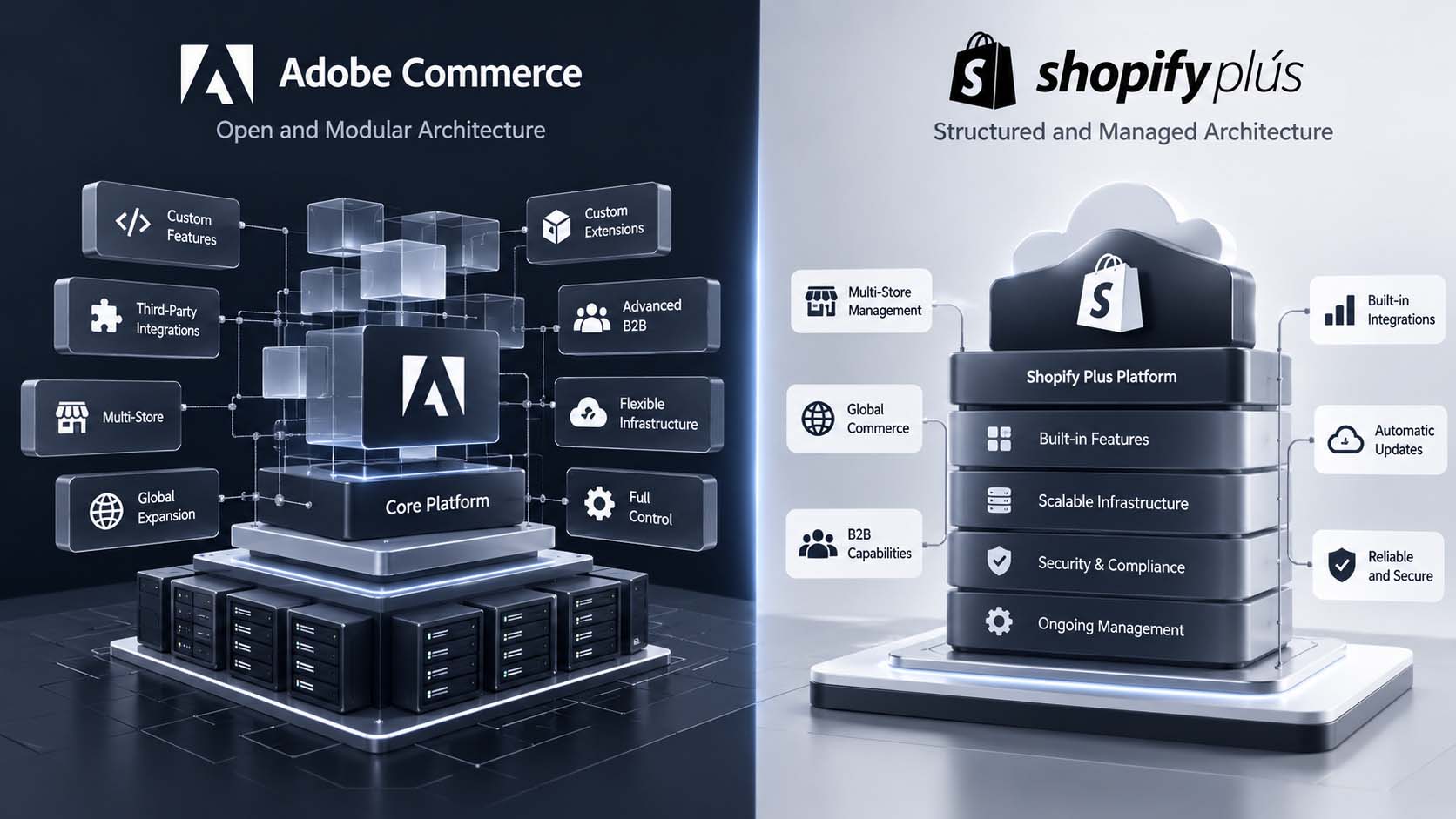
At enterprise scale, thousands of SKUs, complex B2B pricing, multiple storefronts, high transaction volume, the platform decision looks meaningfully different than it does for a small or mid-size store. Both Adobe Commerce (Magento) and Shopify Plus are built to handle serious scale, but they take genuinely different approaches to getting there, and the right choice depends on specifics that only become clear once a business is actually operating at this level. A mismatched platform at this scale is expensive to fix, which is exactly why the decision deserves this level of scrutiny upfront.
What “Enterprise” Actually Means for an eCommerce Platform
At this scale, the platform decision isn’t really about basic functionality, both platforms can handle large catalogs and high traffic. It’s about depth of customization, total cost of ownership over years rather than months, how much the business needs to shape the platform around its own specific, often unusual operational requirements, and how much ongoing technical investment the business is prepared to make versus wanting handled by the platform provider.
Where Adobe Commerce (Magento) Has the Edge
Adobe Commerce’s open architecture gives enterprise businesses essentially unlimited customization potential, genuinely complex B2B pricing logic, highly specific workflow requirements, deep integration with legacy enterprise systems like ERP and CRM platforms that have been in place for years. For businesses whose operations genuinely don’t fit a standard template, insurance-heavy industries, highly regulated sectors, businesses with unusual multi-entity pricing structures, this flexibility is often the deciding factor, since Shopify Plus’s more structured approach can hit real limits for genuinely unusual requirements.
Where Shopify Plus Competes Well
Shopify Plus offers a more managed, predictable experience, hosting, security, and core infrastructure are handled by Shopify directly, which appeals strongly to enterprise businesses that want to focus their internal technical resources on their core business rather than ongoing platform infrastructure management. Shopify Plus has also closed much of the customization gap in recent years, and its broader, more accessible app ecosystem can mean faster time-to-market for standard enterprise needs that don’t require truly unusual customization.
Customization Depth: A Real Differentiator
This is where the two platforms genuinely diverge at enterprise scale. Adobe Commerce’s open-source core means there’s essentially no ceiling on custom development, if a business can specify a requirement, it can almost certainly be built. Shopify Plus, even with its expanded flexibility, still operates within a more structured platform framework; most enterprise needs fit comfortably within that structure, but a business with genuinely unusual, deeply specific operational requirements may find Shopify Plus’s boundaries more limiting than Adobe Commerce’s open architecture.
Total Cost of Ownership at Enterprise Scale
Adobe Commerce generally requires a larger internal or outsourced technical team to manage ongoing development, hosting, and maintenance, a real cost that needs honest accounting beyond the platform’s own licensing fees. Shopify Plus’s subscription cost is higher than standard Shopify, but it includes more of the infrastructure and maintenance burden that Adobe Commerce leaves to the business. At true enterprise scale, the total cost comparison often ends up closer than either platform’s marketing suggests, with the deciding factor coming down more to customization needs than to raw pricing.
Performance and Reliability at High Volume
Both platforms are proven at genuinely high transaction volumes when properly architected, but Adobe Commerce’s performance depends heavily on the quality of its specific implementation and hosting setup, since the business bears more direct responsibility for this layer. Shopify Plus’s performance and uptime are more directly Shopify’s responsibility, offering a degree of built-in reliability that doesn’t depend as heavily on a business’s own technical execution. For businesses without a strong existing technical team, this difference can meaningfully affect real-world reliability, independent of either platform’s theoretical capabilities.
How to Decide Between Them
The decision at enterprise scale usually comes down to one core question: does the business have genuinely unusual, deeply specific operational requirements that justify Adobe Commerce’s open-ended customization and the technical investment it requires, or do its enterprise needs, while substantial, fit within a more structured, managed platform. Businesses with deep legacy system integration needs or highly unusual business logic tend toward Adobe Commerce; businesses prioritizing managed infrastructure and faster time-to-market tend toward Shopify Plus.
How Kanopus Supports Enterprise eCommerce Decisions
We work with enterprise clients to map out their actual operational requirements in detail, legacy integrations, pricing complexity, internal technical resources, before recommending a platform. This grounded, specific assessment, rather than a generic enterprise feature comparison, is what actually determines which platform will serve a business well at the scale it’s operating at.
A Realistic Scenario for Each Platform
Consider a multinational manufacturer selling through several regional subsidiaries, each with distinct pricing, currencies, and complex integration needs with an existing enterprise resource planning system, Adobe Commerce’s open architecture is well-suited to accommodating that level of specificity. Now consider a fast-growing direct-to-consumer brand that has scaled into enterprise territory but still operates a relatively standard storefront model, Shopify Plus’s managed infrastructure and faster time-to-market often serve that business better than the deeper customization Adobe Commerce offers but doesn’t necessarily need.
Why This Decision Deserves Executive-Level Attention
At enterprise scale, the eCommerce platform decision touches far more of the business than a typical IT choice, it affects how sales, operations, finance, and customer service all interact with the company’s revenue engine. This is a decision that benefits from input beyond the technical team alone, genuine alignment between business operations leadership and whoever is evaluating platform fit tends to produce a far better long-term outcome than a decision made in a technical vacuum, disconnected from how the rest of the business actually operates day to day.
Closing Perspective for Enterprise Decision-Makers
Both platforms are legitimate, proven choices for serious enterprise businesses, the failure mode isn’t picking the “wrong” one in some absolute sense, it’s picking either one without a clear-eyed, specific assessment of what the business actually needs. That assessment, done honestly and early, is worth more than any feature comparison chart either platform’s marketing team will show you.
A Note on Platform Lock-In at This Scale
Migrating an enterprise store between platforms later is a significant undertaking at this scale, far more involved than a smaller store’s migration. This is one more reason the initial decision deserves real diligence: both platforms are strong long-term bets when chosen correctly, but reversing a poor fit after years of operation and integration carries real cost and risk that’s far better avoided than remedied.
Final Thoughts for Enterprise Teams
Both Adobe Commerce and Shopify Plus have earned their place as serious enterprise platforms, and either can power a genuinely successful large-scale operation when matched correctly to the business behind it. The work worth investing in upfront is making sure that match is accurate, grounded in real operational requirements rather than brand reputation or a generic enterprise checklist.
What Due Diligence Should Actually Involve
Proper due diligence before this decision involves more than reading feature comparison pages, it means talking to businesses of a comparable size and complexity who’ve actually implemented each platform, requesting detailed proposals that address your specific operational requirements rather than generic enterprise capabilities, and honestly assessing your own organization’s appetite for ongoing technical management versus wanting that burden handled by a platform provider.
Planning for the Migration Itself, Whichever Platform You Choose
Enterprise migrations, onto either platform, benefit enormously from a phased approach rather than a single high-risk cutover: migrating and testing core catalog and customer data first, running parallel systems briefly where feasible, and rolling out additional functionality incrementally rather than all at once. This reduces the risk of a disruptive launch and gives the business multiple checkpoints to catch and correct issues before they affect live customers.
Bringing the Decision Full Circle
At enterprise scale, there’s rarely a universally right answer, only the answer that’s right for a specific business’s operational reality, technical capacity, and growth trajectory. Taking the time to assess that reality honestly, rather than defaulting to whichever platform is more familiar or more aggressively marketed, is what separates a platform decision that serves a business well for a decade from one that becomes a costly constraint within a few years.
The Value of an Independent Assessment
Because both Adobe Commerce and Shopify Plus have strong incentives to position themselves favorably, an independent development partner without a built-in bias toward either platform is often better positioned to give an honest, balanced assessment of which one genuinely fits a specific business’s requirements, rather than a recommendation shaped by which platform the partner happens to specialize in exclusively.
One Final Consideration Before You Decide
It’s worth remembering that platform selection is ultimately in service of the business’s actual customers and operations, not an end in itself. The best decision is the one that lets a business serve its customers reliably, manage its operations efficiently, and grow without unnecessary friction, regardless of which platform’s name ends up on the final contract.
Frequently Asked Questions
Not necessarily, total cost of ownership depends heavily on customization needs and internal technical resources. Adobe Commerce often requires more technical investment, while Shopify Plus bundles more infrastructure into its subscription cost.
Yes, Shopify Plus has significantly expanded its B2B and custom pricing capabilities, though genuinely unusual or deeply complex pricing logic may still be easier to implement on Adobe Commerce's open architecture.
Generally yes, Adobe Commerce requires more ongoing technical management than Shopify Plus, since hosting, security, and infrastructure aren't handled by the platform provider the way they are with Shopify.
Both are proven at high volume when properly implemented, but Shopify Plus's infrastructure reliability is more directly Shopify's responsibility, while Adobe Commerce's reliability depends more on the quality of its specific implementation.
Yes, migrations between enterprise platforms are possible while preserving product, customer, and order data, though a migration at this scale requires careful, phased planning given the complexity typically involved.
Ready to Talk?
If your business is evaluating Adobe Commerce against Shopify Plus for an enterprise store, Kanopus Web Solutions can map your specific operational requirements against what each platform genuinely offers, before any commitment is made. Call +91 79925 99257 or email info@kanopuswebsolutions.com.