

Contact Us +91 79925 99257



Written by Kalpesh Prajapati
Ask five developers which JavaScript framework is best and you’ll likely get five confident, slightly different answers, often shaped more by personal familiarity than objective project fit. React, Angular, and Vue have each carved out genuine, lasting strongholds in different corners of the industry, and all three remain perfectly capable choices in 2026. The right one for a specific business depends far more on project requirements, team composition, and long-term plans than on which framework happens to be trending in developer conversations this particular year.
Understanding what actually separates these three, beyond surface-level syntax differences, makes for a much more confident decision than defaulting to whichever name comes up most often in a quick search.
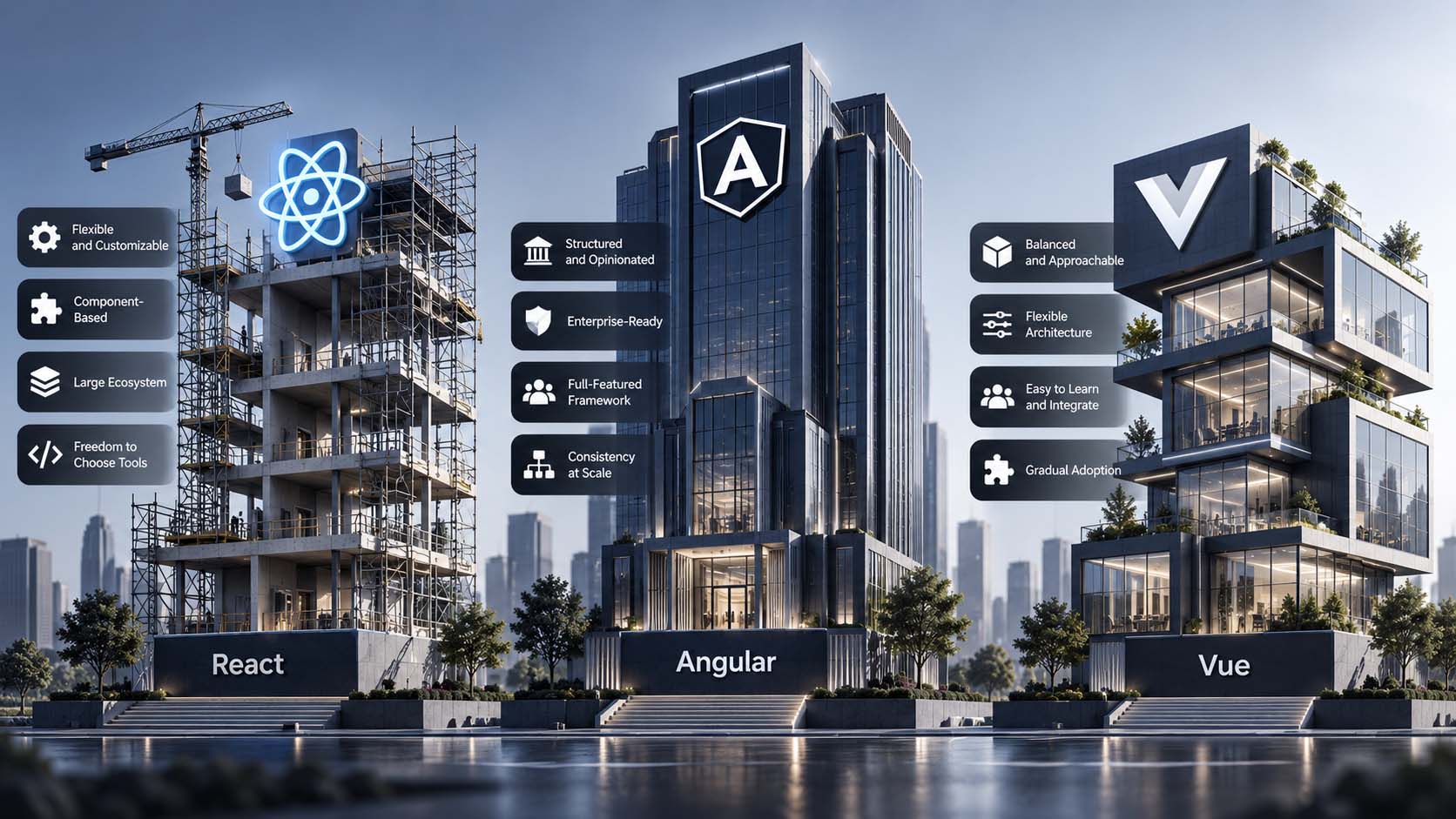
React is a library focused specifically on building user interfaces through reusable components, intentionally leaving many architectural decisions, routing, state management, project structure, to the developer or additional libraries. Angular is a full, opinionated framework that comes with routing, state management, form handling, and a complete project structure built in, designed to give large teams a consistent, enforced way of building. Vue sits somewhere between the two, offering more built-in structure than React while remaining lighter and more flexible than Angular’s fuller framework approach.
This difference in philosophy, library versus framework, flexible versus opinionated, is the real starting point for understanding which one fits a given project, far more than any specific feature comparison.
React’s massive ecosystem and developer community remain its biggest practical advantage. For businesses building complex, highly interactive applications, and needing access to the widest possible pool of experienced developers, React consistently offers the deepest talent market and the most extensive library of pre-built solutions for common problems. Its flexibility also appeals to teams who want control over their own architecture rather than working within a framework’s enforced structure.
Angular’s opinionated, all-in-one structure genuinely benefits large enterprise teams building large, long-lived applications where consistency across many developers matters more than individual flexibility. Built-in TypeScript support, a mature dependency injection system, and enforced architectural patterns reduce the risk of inconsistent code across a large team working on the same codebase over years. Businesses already operating in a heavily Microsoft or enterprise-Java-adjacent technical environment also sometimes find Angular’s structured approach a more natural cultural fit for their existing development practices.
Vue is often praised for striking a genuinely comfortable middle ground, more structure and built-in tooling than React out of the box, but considerably lighter and more approachable than Angular’s full framework. Teams new to modern JavaScript frameworks often find Vue’s learning curve gentler, and its documentation has long been considered among the clearest and most approachable in the ecosystem. For small to mid-size teams wanting solid structure without Angular’s full complexity, Vue remains a genuinely strong, often underrated choice.
React’s flexibility means more early decisions fall on the development team, which app router, which state management approach, giving experienced teams freedom but potentially overwhelming less experienced ones without strong architectural guidance. Angular’s steeper initial learning curve is offset by less ongoing decision-making once a team is trained, since the framework itself dictates much of the structure. Vue tends to be the fastest framework for a new developer to become productive in, which matters for businesses building or managing a team with varying experience levels.
All three frameworks are backed by substantial organizations or communities, React by Meta and an enormous open-source community, Angular by Google with strong enterprise backing, and Vue by an independent, dedicated core team with wide adoption, particularly in Asia and among independent developers. Long-term support concerns are genuinely minimal for any of the three at this point; all have proven multi-year track records and active, ongoing development, so this factor rarely needs to be the deciding one.
Raw performance differences between well-built applications on any of these three frameworks are small enough in practice that they shouldn’t typically be the deciding factor for most business applications. Poor architecture and unoptimized code will hurt performance far more significantly than the underlying framework choice itself, regardless of which one is selected. The far more useful performance question is whether a development team has genuine experience building fast, well-optimized applications in whichever framework gets chosen, not which framework claims the fastest raw benchmark numbers.
Start with your team: what does your current or planned development team already know well, and how much does retraining cost factor into the decision. Next, consider project scale and structure needs: a large, long-lived enterprise application benefits from Angular’s enforced consistency, while a smaller, faster-moving product often benefits from React’s or Vue’s lighter flexibility. Finally, weigh talent availability in your specific hiring market, since a technically excellent framework choice doesn’t help much if it’s genuinely difficult to find developers for in your region or budget.
Consider a fast-growing startup building a customer-facing product with a small, flexible team that wants maximum control over architecture decisions, React’s flexibility and massive talent pool make it a natural fit. Consider a large insurance company building an internal claims processing system maintained by dozens of developers over many years, Angular’s enforced structure and consistency genuinely reduces the risk of the codebase becoming unmanageable as team members rotate in and out. Consider a small agency building a clean, fast marketing site for a client with a tight budget and timeline, Vue’s approachable learning curve and solid defaults let a lean team move quickly without sacrificing structure.
Framework debates online often frame this as a competition with a single correct winner, but that framing doesn’t reflect how these technologies actually get used successfully in the real world. All three power major, successful products used by millions of people daily. The businesses that end up frustrated with their framework choice are rarely the ones who picked the ‘wrong’ framework in some absolute sense, they’re the ones who picked based on hype rather than an honest assessment of their own project and team.
It’s worth asking directly why a development team is recommending a specific framework for your project, and listening for whether the answer references your actual requirements, team, and timeline, or defaults to a general statement about which framework they simply prefer working in. A team that can articulate the specific reasoning behind a recommendation is giving you a decision grounded in your project; a team that can’t is likely optimizing for their own comfort rather than your outcome.
The frontend framework choice rarely exists in isolation from the rest of a business’s technology decisions. A team already invested in Angular for other internal tools may find consistency benefits in extending that choice to a new project, reducing the cognitive overhead of switching contexts between different frameworks. Similarly, a business planning to pair its frontend with Node.js on the backend often finds React or Vue a more natural fit, keeping the entire stack within a cohesive JavaScript ecosystem rather than introducing Angular’s more opinionated, separate conventions into an otherwise lighter-weight system.
It’s worth remembering that framework choice, while genuinely important, is only one of many decisions that determine whether a project ultimately succeeds. Good architecture, clear requirements, skilled execution, and ongoing maintenance discipline all matter considerably more to a project’s long-term health than which of these three capable frameworks ends up being selected. A mediocre implementation in the ‘right’ framework will still underperform a well-executed implementation in a framework that was merely adequate for the task.
Businesses planning a multi-year product should also weigh each framework’s own release cadence and backward compatibility track record. React has generally prioritized gradual, well-communicated changes that minimize breaking existing applications. Angular has historically introduced more significant version-to-version changes, requiring more deliberate upgrade planning. Vue has settled into a steadier, more predictable release pattern in recent years. None of these patterns should be disqualifying on their own, but they’re worth factoring into a realistic maintenance budget over a multi-year horizon.
We evaluate each project against its actual scale, team composition, and long-term maintenance plans before recommending a framework, rather than defaulting to whichever one we happen to use most often. All three remain genuinely strong, well-supported choices in the right context, and our goal is matching the right one to your specific project rather than pushing a one-size-fits-all recommendation across every client we work with.
Products evolve, and a project that started as a simple internal tool might grow into a customer-facing product with real scale and team requirements. It’s worth periodically revisiting whether the original framework choice still fits, rather than assuming the initial decision remains correct indefinitely regardless of how significantly the project’s scope and ambitions have shifted since that first decision was made.
Yes, React remains the most widely used of the three, backed by the largest developer community and talent pool, though Angular and Vue both remain strong, actively maintained options for the right projects.
Vue is generally considered the most approachable for developers new to modern JavaScript frameworks, while Angular tends to have the steepest initial learning curve due to its full, opinionated structure.
Angular's structure particularly benefits large teams building long-lived applications, but it can also work well for smaller projects that want strong built-in structure from the start.
It's possible but generally requires substantial rework, since the three frameworks aren't directly interchangeable. This is why the initial decision deserves careful consideration based on actual project needs.
Not directly on its own, though React is commonly paired with Next.js for stronger SEO, while Angular and Vue have their own server-side rendering solutions (Angular Universal and Nuxt) for similar needs.
Not sure which JavaScript framework fits your project and team? Kanopus Web Solutions can review your requirements and recommend the one that will serve your business well, not just the one we’re most comfortable pitching. Call +91 79925 99257 or email info@kanopuswebsolutions.com.