

Contact Us +91 79925 99257



Written by Kalpesh Prajapati
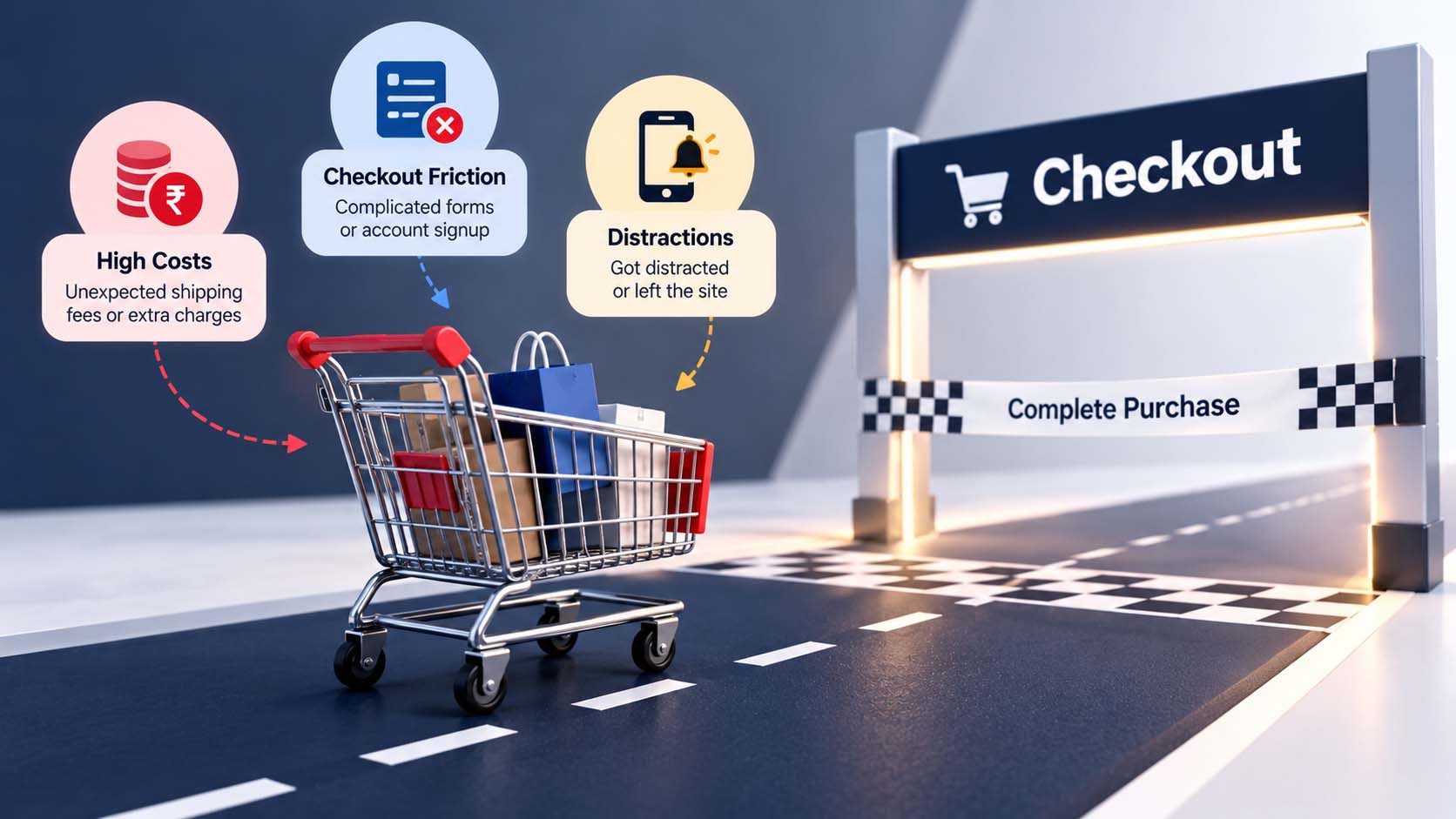
The average online store loses a significant majority of carts before checkout ever completes, visitors who added a product, showed genuine purchase intent, and then simply left. For a Shopify store, understanding exactly why this happens, and which fixes actually move the number, matters more to revenue than almost any other single optimization a business can make. Even small improvements here tend to outperform the equivalent spend on acquiring new traffic.
The most common reasons cluster around a handful of specific frustrations: unexpected costs appearing late in checkout, shipping fees, taxes, service charges, a checkout process that requires too many steps or too much unnecessary information, limited payment options that don’t match how a specific customer wants to pay, and simple distraction, a visitor fully intending to return and complete the purchase later, who then forgets or gets pulled toward a different priority. Understanding which of these is actually driving abandonment on a specific store, rather than assuming, is the first step toward fixing it.
Every additional step or required field in a checkout flow is an opportunity for a visitor to hesitate or abandon. A streamlined checkout asks only for genuinely necessary information, offers a guest checkout option rather than forcing account creation, and keeps the entire process to as few screens as the payment and shipping logic genuinely requires. Shopify’s native checkout is already well-optimized by default, but businesses customizing it should be cautious about adding friction back in through unnecessary custom fields or steps.
Few things kill a purchase decision faster than a total price that jumps significantly higher than expected right at the final step. Displaying estimated shipping costs and taxes as early as possible in the shopping experience, a shipping calculator on the product or cart page, for instance, sets accurate expectations before a customer has mentally committed to a specific price point, reducing the shock that drives last-second abandonment.
Different customers have strong, sometimes non-negotiable preferences for how they pay, credit card, digital wallets, buy-now-pay-later options, and regionally popular payment methods. A store offering only one or two payment options loses customers who simply can’t or won’t complete a purchase through the available methods. Shopify’s payment app ecosystem makes adding popular regional and alternative payment options relatively straightforward, and the investment tends to pay for itself quickly in recovered sales.
A well-timed abandoned cart email sequence recovers a meaningful share of otherwise lost sales. The most effective sequences send a first reminder within an hour or two of abandonment, while the purchase intent is still fresh, followed by a second message a day or so later that may include a modest incentive if appropriate for the business. Overly aggressive discounting in these emails can train customers to abandon carts intentionally expecting a coupon, so this tactic works best used thoughtfully rather than as a blanket default.
Security badges, clear return and refund policy links, and visible customer service contact information at the checkout stage all reduce the last-minute hesitation that causes some abandonment, particularly for first-time customers who haven’t yet built trust with a store. This matters more than it might seem: a customer who’s ready to buy but suddenly uncertain about a store’s legitimacy will often abandon rather than proceed, even after investing time building a cart.
A significant share of Shopify traffic, often the majority, now arrives on mobile, and a checkout experience that works smoothly on desktop but feels cramped or awkward on a phone loses customers specifically at the final, most important step. Testing the actual checkout flow on a real phone, not just previewing it on a desktop browser resized smaller, catches friction points that are easy to miss otherwise.
We start by reviewing a store’s actual abandonment data, where in the funnel customers are dropping off, rather than applying generic fixes blindly. From there, we prioritize changes based on where the data shows the biggest opportunity, testing adjustments systematically so a business can see concretely what’s actually moving the number rather than guessing.
Not every fix will move the needle equally for every store, since the specific reasons behind abandonment vary by audience, price point, and industry. A/B testing specific checkout changes, a simplified form, an added payment option, earlier shipping cost visibility, against real visitor data shows concretely what’s actually working for a specific store’s customers, rather than relying purely on general best practices that may or may not apply. Shopify’s analytics, combined with a dedicated conversion tracking setup, make this kind of testing genuinely accessible even for smaller stores without a dedicated data team.
A well-optimized Shopify checkout funnel shows costs early, offers guest checkout alongside account creation, supports multiple relevant payment methods, loads quickly on mobile, and includes clear trust signals at the exact moment a customer is deciding whether to complete the purchase. None of these elements alone guarantees a dramatically lower abandonment rate, but together they remove the accumulated friction that causes a meaningful share of otherwise interested customers to quietly leave without buying.
A single percentage point improvement in checkout completion might sound modest, but applied across a store’s total traffic and order volume over a year, it often represents meaningful, recurring revenue that didn’t require any additional marketing spend to capture. This is part of why checkout optimization deserves ongoing attention rather than a one-time project treated as finished once a handful of fixes go live.
If a Shopify store has never had a dedicated checkout review, the fastest starting point is checking Shopify’s own analytics for where in the funnel customers are dropping off most, then testing the actual checkout flow personally on both desktop and mobile as a new customer would experience it. This quick initial audit, taking well under an hour, usually surfaces at least one or two clear, fixable friction points before any deeper investigation is even needed.
Reducing cart abandonment isn’t about finding one magic fix, it’s about systematically removing the small frictions that accumulate across a checkout experience, cost surprises, unnecessary steps, missing payment options, mobile friction, until completing a purchase feels as effortless as the decision to buy already was in the customer’s mind.
Customer expectations around checkout experience keep rising as more stores invest in this area, which means a checkout flow that felt perfectly smooth a couple of years ago can start to feel dated by comparison today. Treating checkout optimization as an ongoing part of running a store, revisited periodically rather than fixed once and forgotten, keeps a store competitive with customer expectations that continue to shift.
Beyond basic security badges, displaying genuine customer reviews, clear satisfaction guarantees, and recognizable payment logos near the final purchase step reassures hesitant buyers at exactly the moment they’re deciding whether to complete the transaction. This is particularly impactful for new or lesser-known brands, where a first-time visitor hasn’t yet built the kind of trust that a more established retailer carries automatically into every transaction.
No single round of fixes eliminates cart abandonment entirely, some level of it is simply a normal part of how people shop online, browsing, comparing, deciding later. The realistic goal isn’t zero abandonment, it’s steadily reducing the share that’s happening for genuinely fixable reasons within a store’s own control.
It’s easy to focus marketing energy entirely on driving more traffic to a store, since that effort feels more visible and more directly tied to growth. But a store converting a higher share of the traffic it already has effectively gets a revenue increase without any additional ad spend at all, which makes checkout optimization one of the highest-leverage, most underrated investments a growing Shopify store can make.
Not every store has the internal time or expertise to run a full checkout audit independently, and that’s a reasonable thing to bring in outside help for. A development partner experienced specifically in Shopify checkout optimization can usually identify the highest-impact opportunities within a short initial review, giving a store a clear, prioritized action plan rather than a vague sense that something could probably be improved.
Checkout optimization rarely produces a single dramatic jump in conversion, it tends to show up as a steady, cumulative improvement across many small fixes tested over time. Store owners who stay patient and methodical with this process, rather than expecting one change to transform the numbers overnight, consistently see the strongest long-term results.
Rates vary by industry, but a significant majority of carts typically don't convert to a completed purchase, which is why even modest improvements in this area can meaningfully impact revenue.
Yes, a well-timed sequence recovers a meaningful share of otherwise lost sales, though overly aggressive discounting in these emails can encourage customers to abandon carts intentionally.
Generally no. Offering guest checkout alongside optional account creation reduces friction and tends to improve conversion compared to requiring an account upfront.
Very important, since a large and often growing share of traffic arrives on mobile. A checkout that isn't genuinely tested and optimized for phones loses customers at the most critical step.
Yes, customers with a strong preference for a specific payment method they can't use will often abandon rather than switch, so broader payment support can directly recover otherwise lost sales without any other change to the store.
If cart abandonment is quietly costing your Shopify store real revenue, Kanopus Web Solutions can review your checkout data and identify exactly where to focus first, with changes tested against real visitor behavior. Call +91 79925 99257 or email info@kanopuswebsolutions.com.