

Contact Us +91 79925 99257



Written by Kalpesh Prajapati
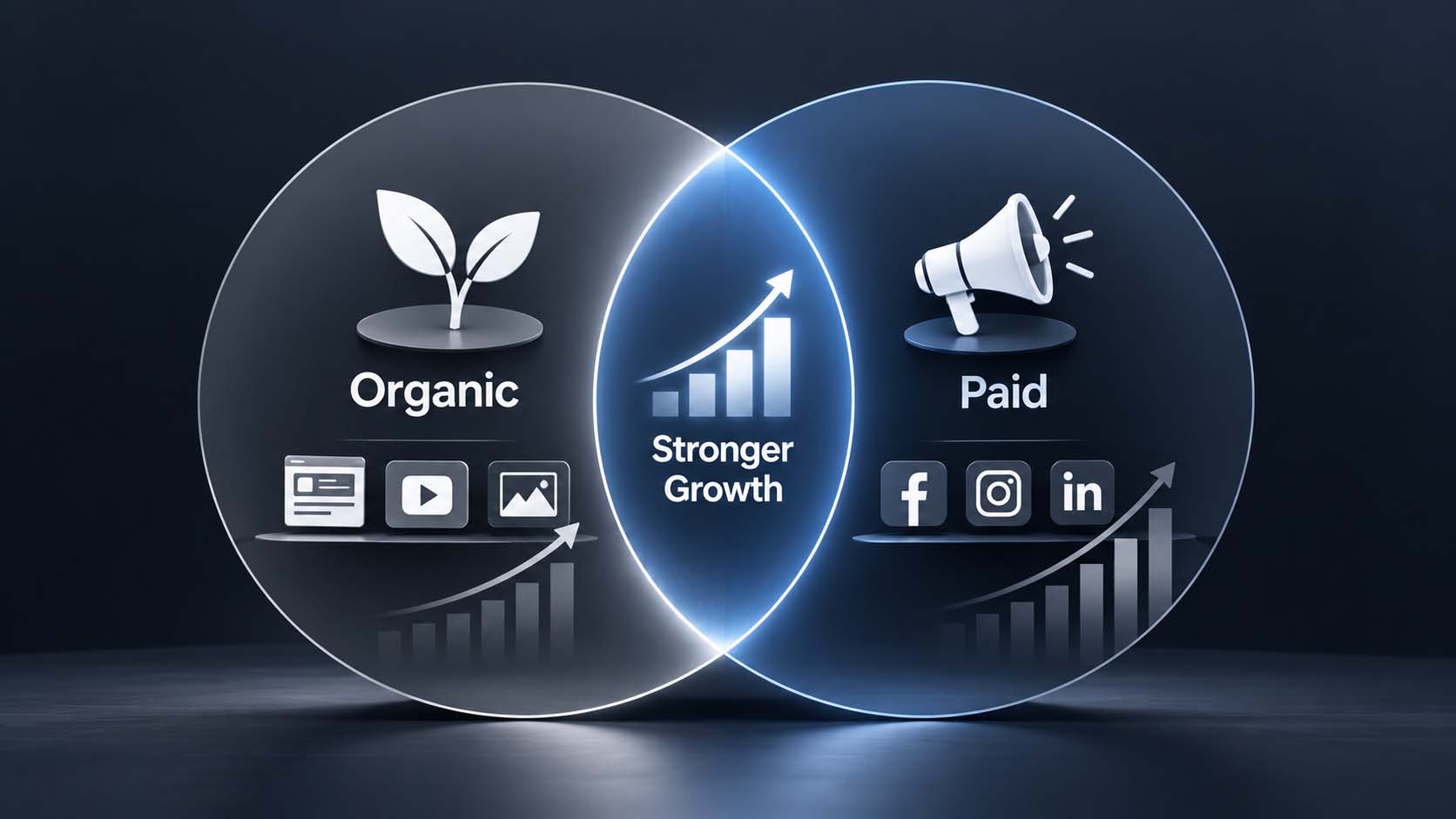
Every business with a social media presence eventually faces the same budget question: invest more in organic content, or shift spend toward paid promotion? The honest answer is that most businesses need both, working together rather than competing for the same limited budget, but figuring out the right balance for a specific business, industry, and growth stage takes more thought than simply splitting a budget evenly down the middle.
Organic content builds long-term brand affinity, consistent presence, a recognizable voice, a community that engages because they genuinely want to, not because an algorithm paid to put content in front of them. It’s also the foundation that makes paid advertising more effective later, since audiences arriving at a brand’s profile through an ad convert better when the surrounding organic content looks active, authentic, and trustworthy rather than abandoned.
The tradeoff is reach. Organic content, particularly on platforms like Instagram and Facebook, now reaches only a small fraction of a page’s total following without any paid boost, which means organic alone struggles to drive significant, predictable growth for most businesses working with a limited following.
Paid social offers precise targeting, predictable reach, and measurable results tied directly to spend, letting a business put content in front of exactly the audience it wants, at a scale organic reach simply can’t match without years of accumulated following. It’s genuinely effective for driving specific, trackable outcomes: website traffic, leads, direct sales, brand awareness among a carefully defined new audience.
The tradeoff here is that paid reach stops the moment spending stops. Unlike organic content, which can continue generating value through shares, saves, and ongoing discoverability, paid reach is rented, not owned, and doesn’t compound the same way a growing, genuinely engaged organic following does over time.
Organic and paid social serve genuinely different, complementary purposes rather than competing for the exact same outcome. Organic builds the brand foundation, voice, trust, community, that makes every other marketing channel work better, including paid ads themselves. Paid social accelerates reach and drives specific, time-sensitive outcomes that organic alone can’t reliably deliver at scale. Treating them as a single coordinated strategy, rather than two separate, competing line items, consistently outperforms investing exclusively in either one.
Strong organic content frequently becomes the best-performing paid ad creative, since content that already resonates with an existing audience tends to perform well when boosted to a wider one. Paid campaigns, in turn, bring new visitors to a profile where strong, consistent organic content converts a first impression into an actual follow or purchase decision. Retargeting, showing ads specifically to people who already engaged with organic content, is one of the more effective and underused tactics connecting the two approaches directly.
A reasonable starting point for most small to mid-size businesses weights spend toward whichever approach matches their current growth stage: businesses still building brand awareness and an initial following often benefit from heavier organic investment paired with modest paid testing, while businesses with an established presence looking to scale specific outcomes, leads, sales, often benefit from shifting more budget toward paid, while maintaining organic consistency to support it. This split should shift over time based on actual performance data, not stay fixed indefinitely.
Declining organic reach despite consistent, quality content posting is a signal to increase paid investment to maintain visibility. Strong engagement on organic posts but limited follower growth suggests paid awareness campaigns could accelerate what’s already working. Rising paid acquisition costs without a corresponding increase in organic brand searches can signal it’s time to invest more in organic brand-building to support and eventually lower paid costs over time.
Pouring budget entirely into paid ads while letting organic content go stale often backfires, since visitors arriving through an ad who then check a brand’s profile and find it inactive lose confidence right before converting. The opposite mistake, relying entirely on organic and avoiding paid altogether, often means growth plateaus well below what the business could otherwise achieve, since organic reach alone has become genuinely limited on most major platforms without supplemental paid support.
A visually-driven consumer brand selling physical products often sees strong organic engagement on platforms like Instagram and Pinterest, making organic content a genuinely powerful growth driver worth significant investment. A B2B service business, by contrast, often finds organic reach on most consumer social platforms limited regardless of content quality, making paid campaigns, particularly on LinkedIn, a more reliable path to the specific decision-makers they’re trying to reach. Understanding these industry-specific patterns, rather than applying a generic split, leads to a far more effective budget allocation.
Organic and paid social success should be measured differently, holding organic content to the same direct conversion standard as paid ads often produces an unfairly pessimistic view of what organic is actually accomplishing. Organic metrics worth tracking include engagement rate, follower growth quality, and brand search volume over time, while paid metrics should focus on cost per result, conversion rate, and return on ad spend. Blending these into a single combined scorecard, with appropriate weight given to each channel’s actual role, gives a far more accurate picture of overall social media performance.
Rather than setting a budget split once and leaving it unexamined, a short monthly review comparing organic engagement trends against paid performance metrics keeps the balance responsive to what’s actually happening, rather than based on assumptions that may have been accurate six months ago but no longer reflect current platform algorithm changes or audience behavior shifts.
Consider a business in its first year, building initial brand awareness with a modest following and a limited budget, heavy organic investment paired with small, targeted paid tests makes sense here, since there isn’t yet enough proven content or audience data to justify large paid spend. Now consider that same business two years later, with an established voice, a track record of what content performs well, and clear data on which paid campaigns convert, the mix naturally shifts toward heavier, more confident paid investment built directly on the foundation organic content already established.
This evolution isn’t a one-time decision, it’s a gradual shift that should track a business’s actual growth stage rather than following a fixed formula applied regardless of where the business currently stands.
Businesses sometimes get stuck searching for the theoretically perfect organic-to-paid ratio before committing to either, which delays actually building momentum on either channel. In practice, a reasonable starting split executed consistently over several months, then adjusted based on real results, consistently outperforms an endlessly debated, never-quite-finalized strategy that never actually gets a fair chance to demonstrate what’s working.
No budget allocation strategy compensates for genuinely weak content. Paid spend amplifies whatever it’s given, strong content reaches more people effectively, weak content simply fails faster and more expensively in front of a larger audience. This is worth remembering before shifting budget toward paid as a fix for underperforming organic content; often the better first step is improving the content itself, then scaling what’s proven to work with paid support behind it.
We start by understanding a business’s current stage, existing following, available budget, and specific goals, before recommending a split between organic and paid investment. That mix gets revisited regularly based on real performance data, rather than set once and left unchanged regardless of how the business and its audience evolve over time, with monthly reviews keeping the strategy genuinely responsive.
Businesses adjusting their organic-to-paid balance for the first time should expect a short adjustment period before clear patterns emerge, typically six to eight weeks of consistent execution before enough data exists to confidently evaluate whether the new mix is working. Judging results too early, after just a week or two, often leads to premature, poorly-informed changes that prevent any approach from getting a genuinely fair test.
The right organic-to-paid split can also vary by platform, not just by business. Instagram and TikTok often reward genuinely engaging organic content with meaningful reach even without a budget behind it, while LinkedIn and Facebook have increasingly limited organic business reach, making paid investment more necessary to achieve comparable visibility. A business active across multiple platforms may reasonably run a different organic-to-paid mix on each one, rather than applying a single blended ratio uniformly everywhere.
Most new businesses benefit from building some organic foundation first, voice, consistency, initial content, before scaling paid spend, though modest paid testing alongside organic growth is also reasonable from the start.
There's no universal number, it depends on your growth stage and goals, but most established businesses benefit from allocating a meaningful, ongoing portion of budget to paid rather than relying on organic reach alone.
Indirectly, yes. Paid ads bring new visitors who may then follow and engage with your organic content, and strong organic content often performs well when used as paid ad creative.
It's possible but increasingly difficult given how limited organic reach has become on most major platforms, so most businesses see stronger, more predictable growth by combining both approaches.
Track whether paid acquisition costs are trending favorably, whether organic engagement remains healthy, and whether overall growth matches your goals, adjusting the mix based on what the data actually shows.
Not sure if your social media budget is split the right way between organic and paid? Kanopus Web Solutions can assess your current performance and build a strategy that balances both effectively.
Call +91 79925 99257 or email info@kanopuswebsolutions.com.