

Contact Us +91 79925 99257



Written by Kalpesh Prajapati
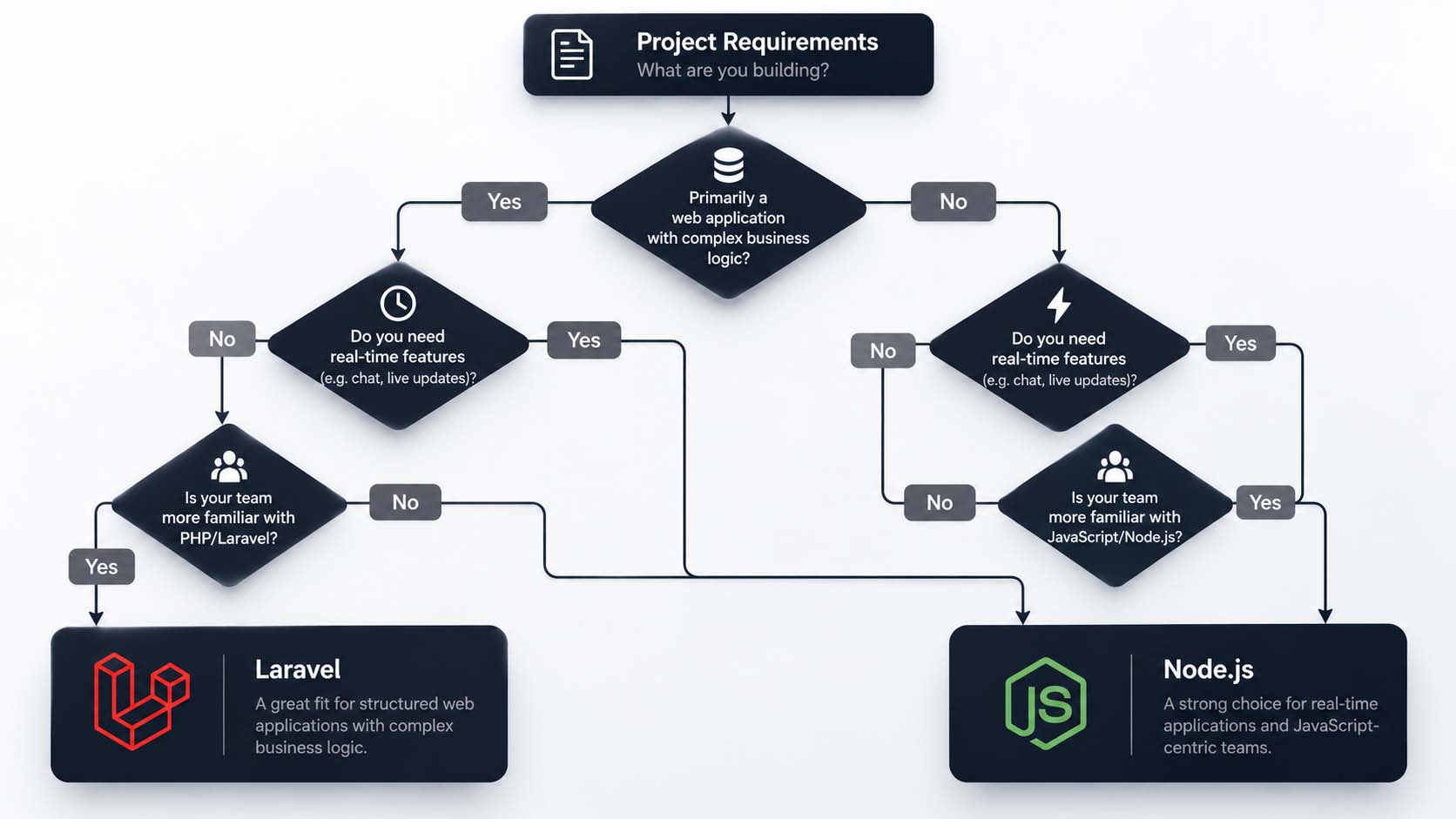
Laravel and Node.js represent two genuinely different approaches to building a backend: one a full, structured PHP framework with deep built-in tooling, the other a flexible, event-driven JavaScript runtime that requires more assembly but offers more architectural freedom. Both are proven, actively maintained technologies, and the right choice depends far more on what a specific application needs to do than on which technology is more fashionable in developer circles this year.
Laravel is a complete, opinionated framework built on PHP, providing structured tools for authentication, database handling, routing, and security out of the box, designed so a team can focus on business logic rather than reinventing common infrastructure. Node.js is a JavaScript runtime, not a framework itself, that excels at event-driven, non-blocking operations; building a comparable application typically means assembling Node.js with additional frameworks like Express to get similar structure. This difference in starting point, complete framework versus flexible runtime, shapes much of how each technology fits different projects.
Applications with substantial business logic, custom CRMs, admin panels, systems with multiple user roles and complex data relationships, benefit from Laravel’s built-in structure and mature tooling for exactly these patterns. Laravel’s Eloquent ORM makes modeling complex, interconnected data genuinely straightforward, and its built-in authentication, authorization, and validation systems reduce the risk of common security mistakes that come from building these systems from scratch in a less structured environment.
Applications with genuine real-time requirements, live chat, collaborative tools, live dashboards, real-time notifications, benefit significantly from Node.js’s event-driven architecture and native support for technologies like WebSockets. Businesses already building their frontend in React or another JavaScript framework also often favor Node.js specifically to keep their entire team working in a single language, simplifying hiring, code sharing, and day-to-day development.
Laravel’s opinionated structure means less upfront architectural decision-making, the framework largely dictates how things should be organized, which benefits teams that want to move quickly without debating foundational choices repeatedly. Node.js’s flexibility means more early decisions fall to the development team, which libraries to use for routing, authentication, and data handling, giving experienced teams more control but requiring more deliberate architectural planning to avoid an inconsistent, harder-to-maintain codebase over time.
Laravel developers are widely available, particularly in markets with a strong existing PHP and WordPress ecosystem, which can simplify hiring for businesses in those regions. Node.js developers, often coming from a JavaScript or frontend background, are also broadly available, especially in markets with strong modern web development talent. The more relevant hiring question is usually which technology an existing team already knows well, since retraining a comfortable team onto an unfamiliar technology carries real cost and slows down early project velocity.
For most typical business applications, standard CRUD operations, admin panels, business logic-heavy systems, the practical performance difference between a well-built Laravel application and a well-built Node.js application is small enough that it shouldn’t be the deciding factor. Node.js shows a clearer, more meaningful performance advantage specifically in high-concurrency, real-time scenarios, exactly the situations where its event-driven architecture was designed to excel in the first place.
Start with the application’s actual requirements: does it need genuine real-time functionality, or is it primarily traditional business logic and data management. Next, factor in your existing team’s skillset and your broader technology ecosystem, is this extending a WordPress or PHP-based system, or building alongside an existing React or JavaScript frontend. These practical, project-specific considerations should drive the decision far more than general opinions about which technology feels more modern.
Consider a professional services firm building a custom client portal with document management, scheduling, and account permissions, Laravel’s structured approach to authentication and data relationships handles this reliably with minimal custom infrastructure work. Consider a logistics startup building a live tracking and notification system where customers and drivers need instant, continuous updates, Node.js’s event-driven architecture is purpose-built for exactly this kind of constant, real-time data flow. Neither business made a wrong choice, each matched their technology to what their application genuinely needed to do well.
Regardless of which technology a business selects, the discipline behind the implementation, clean data structure, proper security practices, genuine testing, consistently matters more than the underlying language choice itself. A well-built Laravel application will outperform a poorly architected Node.js application, and the reverse holds equally true. This is worth remembering when evaluating a development partner: their architectural discipline deserves at least as much scrutiny as their stated technology preference.
Before finalizing a backend choice, ask specifically what about your application’s requirements points toward one technology over the other, and what would need to change for that recommendation to flip. A team that can walk through this reasoning concretely is giving you a decision grounded in your actual project, not a default answer applied regardless of what you’re building.
Laravel’s structured conventions make it easier for a new developer to step into an existing project and understand how things work, since the framework enforces consistent patterns regardless of who originally built it. Node.js’s greater flexibility means a new developer joining a project needs to first understand the specific architectural choices a previous team made, which can take longer if those choices weren’t clearly documented. This difference matters more for businesses anticipating team turnover or bringing in outside developers periodically than for a stable team planning to maintain the application themselves long-term.
Initial development cost is only part of the picture. Laravel’s built-in tooling can reduce ongoing maintenance overhead for complex business logic applications, since less custom infrastructure needs to be maintained over time. Node.js’s efficiency for real-time features can reduce infrastructure costs at scale for applications genuinely built around that strength. Evaluating total cost of ownership over a realistic multi-year horizon, not just the initial build quote, gives a far more accurate picture of which technology is actually more cost-effective for a specific project.
As businesses continue building more interactive, real-time features into otherwise traditional applications, live chat support bolted onto a standard customer portal, for instance, this comparison increasingly resolves into a hybrid answer rather than a single either-or choice. Understanding both technologies well enough to recognize when a hybrid approach genuinely serves a project better than forcing everything into one technology is an increasingly valuable skill for any team making these architectural decisions.
We evaluate each project against its actual technical requirements and existing ecosystem before recommending Laravel or Node.js, both are genuinely capable, well-supported technologies in our hands. The right answer depends entirely on what a specific application needs to do, the team that will maintain it, and how it fits into a business’s broader technical environment, not a default preference applied regardless of fit or trend.
Neither Laravel nor Node.js shows any sign of declining relevance or support in the foreseeable future, both are backed by large, active communities and continued investment from their respective ecosystems. Businesses shouldn’t feel pressure to choose based on which technology seems like it might be more ‘future-proof’, both are safe, durable bets; the decision genuinely comes down to project fit rather than any meaningful risk of obsolescence with either option.
Both Laravel and Node.js are mature, trustworthy technologies capable of powering serious, successful business applications. The genuine risk in this decision isn’t picking the ‘wrong’ one in some absolute sense, it’s picking without a clear, honest understanding of what your specific application actually needs from its backend, and committing to that understanding before development begins rather than discovering the mismatch well after launch.
If your business expects to build and maintain multiple applications over the coming years, it’s worth thinking beyond a single project’s immediate technical needs toward building a team with genuine depth in whichever technology becomes your primary platform. Spreading development across both Laravel and Node.js for different projects can work well, but it does mean maintaining expertise in two ecosystems rather than building deeper, more efficient expertise in one, a tradeoff worth weighing against your business’s realistic appetite for managing that added complexity.
Once an application is live, it’s worth monitoring a few specific signals regardless of which technology was chosen: response times under real user load, how often the application needs manual intervention to handle edge cases the original architecture didn’t anticipate, and how quickly new features can be added without introducing regressions elsewhere. These signals, more than the original technology debate, indicate whether the implementation itself was sound.
Generally yes, Laravel's built-in structure for common tasks like authentication and database handling means less initial setup compared to assembling a comparable Node.js application from individual libraries.
It's a reasonable factor favoring Node.js, since it keeps your team working in a single language, but it shouldn't override genuine technical requirements if Laravel is otherwise a better fit for your application's needs.
Laravel has added real-time capabilities through tools like Laravel Echo and WebSockets support, but Node.js's architecture remains the more natural fit for applications with heavy, genuine real-time requirements.
Costs depend more on project complexity and the development team's expertise than on the base technology choice, though mismatching technology to actual project needs tends to introduce hidden costs over time.
Yes, some businesses run a Laravel-based core application alongside a separate Node.js service handling specifically real-time features, integrating the two through APIs.
Not sure whether Laravel or Node.js is the right fit for your next project? Kanopus Web Solutions can review your actual requirements and team setup before recommending a backend. Call +91 79925 99257 or email info@kanopuswebsolutions.com.