

Contact Us +91 79925 99257



Written by Kalpesh Prajapati
Drag-and-drop website builders have gotten genuinely good. Wix, Squarespace, and similar platforms let a business owner put together a reasonable-looking website in an afternoon, no developer required. That ease of use is real, and for some businesses, it’s exactly the right fit. But “easy to start” and “right for your business long-term” aren’t always the same thing, and the gap between them tends to show up right around the time a business starts actually depending on its website to grow.
WordPress, by contrast, has a steeper initial learning curve but very little ceiling on what it can eventually become. Understanding where each option genuinely wins, rather than relying on generic marketing claims from either side, makes for a much better decision than picking whichever platform had the slicker onboarding video. This comparison deserves real thought rather than a snap decision, since switching platforms later is almost always more disruptive than getting the choice right the first time.
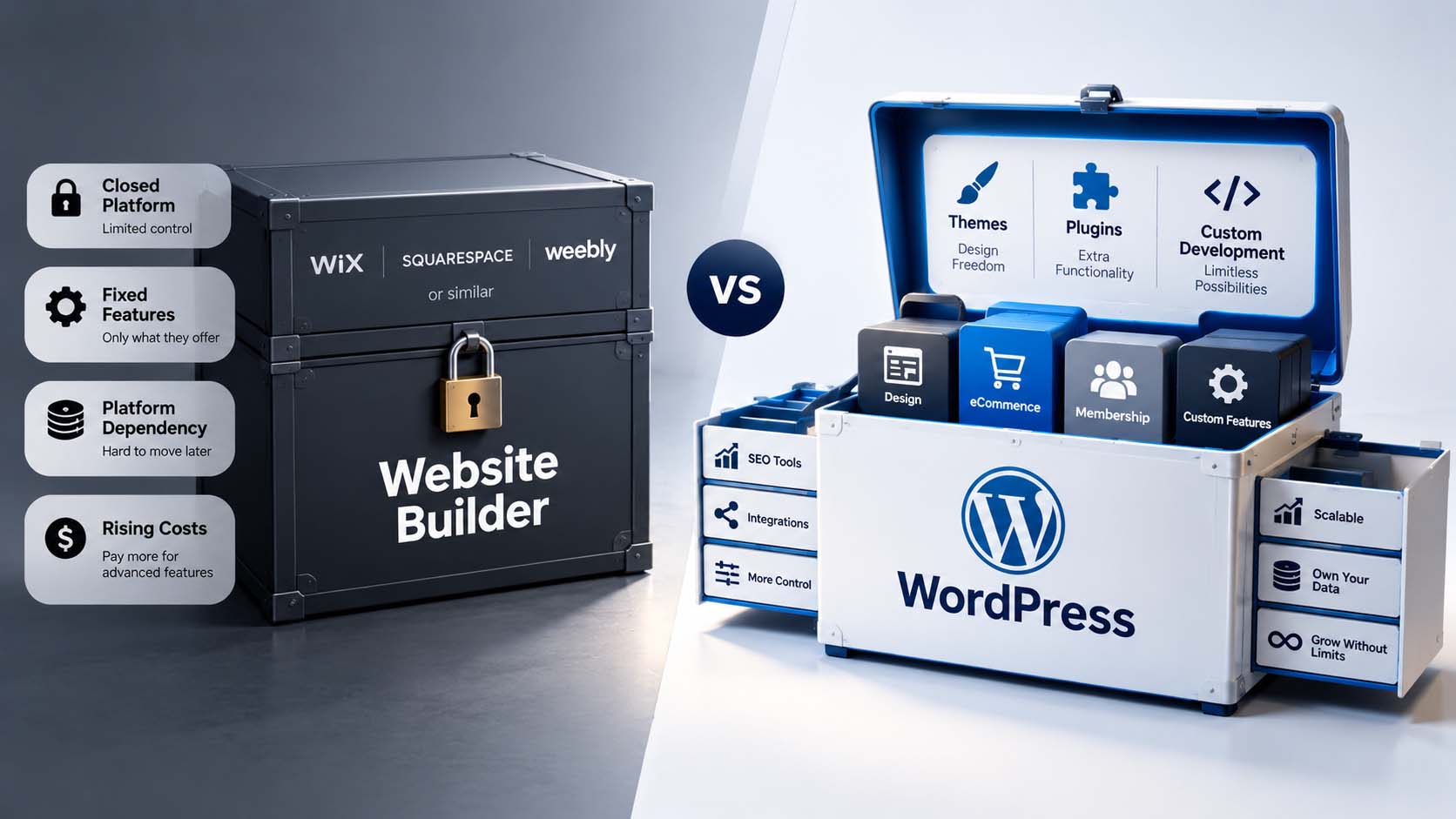
Website builders are closed systems: the company behind the platform controls the hosting, the available features, and the pace of new functionality. WordPress is open-source software that can be installed on any hosting provider, with an enormous ecosystem of themes, plugins, and custom development options built by a global community rather than a single company. This difference sounds abstract until a business actually needs something the builder’s platform doesn’t offer, at which point the builder’s closed nature becomes a real, sometimes costly, limitation.
This openness is also why WordPress powers a vastly larger share of the web than any single website builder. It isn’t locked into one company’s roadmap, pricing decisions, or feature priorities, which matters more than it seems once a business has invested years of content and traffic into a site.
For a very small business, a solo service provider, or anyone who needs a simple, presentable website fast and has no plans to grow it into anything more complex, a website builder is a legitimate, sensible choice. Hosting, security updates, and basic functionality are all handled automatically, with no need to think about technical maintenance at all. The visual, drag-and-drop editing experience is also generally more approachable for a complete beginner than WordPress’s slightly more technical interface, especially for a one-person operation with no plans to hire developer help.
The moment a business needs something specific, a custom booking system, a membership area, deep eCommerce functionality, an integration with a specific internal tool, WordPress’s plugin ecosystem and custom development options almost always have a path forward. Website builders, by design, cap what’s possible within their platform; WordPress generally doesn’t have that ceiling, since custom code can always extend it further.
Content-heavy businesses also tend to outgrow website builders faster than they expect. A growing blog archive, detailed SEO control, and complex content organization are all areas where WordPress’s maturity and purpose-built content tools meaningfully outperform what most website builders offer, even their more advanced plans.
A website built on a proprietary builder lives entirely within that company’s platform. If the company changes its pricing, discontinues a feature, or simply isn’t around in a few years, a business’s website and its content go with it, often with limited or no ability to export cleanly to another platform. A WordPress website, hosted independently, is something a business genuinely owns: the files, the database, and the content can move to any host at any time, with no platform dependency dictating the business’s options.
Website builders advertise low monthly starting prices, but costs climb quickly once a business needs eCommerce functionality, removes platform branding, or adds premium features, often landing in a similar monthly range to a modestly priced WordPress hosting plan. WordPress itself is free, with costs coming from hosting, premium themes or plugins if needed, and development time for anything custom. For a simple site, the total cost is often comparable between the two. For a site that grows in complexity, WordPress tends to become the more cost-effective option over a multi-year horizon, since it avoids the recurring premium-tier fees many builders charge for functionality WordPress includes through free or low-cost plugins.
Both platforms can rank well in search results, but WordPress generally offers more granular SEO control: detailed meta tag management, deeper structured data options, and a far larger ecosystem of SEO-focused plugins and tools built specifically around search optimization. For a business planning to invest seriously in organic search traffic over time, this level of control compounds into a real advantage as a site’s content library grows.
Website builders have improved their SEO tools significantly, and for a business with modest organic growth ambitions, they’re generally sufficient. But a business planning aggressive content marketing or competitive SEO targeting is likely to hit the builder’s ceiling well before WordPress’s.
The decision comes down to a realistic assessment of where the business is headed, not just where it is today. A business that genuinely expects to stay simple, a basic informational site with no growth ambitions beyond that, can reasonably choose a website builder and be perfectly well served. A business planning to grow its content, add custom functionality, scale an online store, or invest seriously in SEO over the coming years is generally better served starting on WordPress, even if it takes slightly more effort to get the first version live.
This is a pattern worth planning for upfront rather than discovering the hard way. A business starts on a builder because it’s quick and affordable, grows its content and customer base over a year or two, and then hits a wall: a feature the business genuinely needs isn’t available, isn’t well supported, or costs an unreasonable premium to unlock. At that point, the business faces a migration, moving content, redesigning within WordPress’s different system, and often rebuilding SEO signals that don’t transfer cleanly from a closed platform.
This migration is rarely catastrophic, but it is disruptive and costly in a way that could often have been avoided by starting on WordPress in the first place, if the business had honestly assessed its growth trajectory from the start rather than optimizing purely for the fastest, cheapest initial launch.
For businesses genuinely torn between ease of use and long-term flexibility, modern WordPress page builders have narrowed the usability gap considerably. Visual, drag-and-drop editing tools now exist within the WordPress ecosystem that offer much of a website builder’s simplicity while still running on WordPress’s open, extensible foundation underneath. This middle ground lets a business get a reasonably fast, approachable setup experience without locking itself into a closed platform’s long-term limitations, worth exploring before assuming the only choice is between a simple builder and a fully custom WordPress build.
We ask directly about a business’s plans for the next two to three years before recommending a platform, not just what the website needs to do on day one. That forward-looking conversation, more than any feature comparison, tends to reveal whether a website builder’s simplicity is a genuine fit or a limitation the business will likely outgrow sooner than expected, and it shapes a recommendation grounded in the specific business rather than a generic pitch for whichever platform is easier to sell.
Rather than comparing platforms in the abstract, it helps to compare actual plan tiers against actual WordPress hosting costs for a comparable feature set: can you remove platform branding without an expensive upgrade, does the plan include the eCommerce functionality you’ll likely need within a year, and are there limits on traffic, storage, or bandwidth that could become a real constraint as the business grows. These specifics, not the advertised starting price, are what actually determine whether a website builder remains cost-effective once a business is genuinely using it.
A website is rarely a static asset, it tends to grow alongside the business it represents, new services, new content, new ways of engaging customers. Choosing a platform with room to grow into that future, rather than one that only barely fits today’s modest starting needs, is one of the more consequential early decisions a business makes about its own digital presence, even though it rarely feels that significant at the time.
A small number of businesses successfully run a lightweight builder site for an early, low-stakes test of an offer or market, then deliberately rebuild on WordPress once initial validation confirms the business has real traction worth investing in properly. This staged approach can make sense for a genuinely uncertain, early-stage idea, but it’s worth entering into deliberately, as a conscious test-then-build strategy, rather than accidentally ending up there after outgrowing a builder that was never meant to be permanent.
WordPress has a slightly steeper initial learning curve, but modern WordPress themes and page builders have narrowed that gap considerably, while still offering far more long-term flexibility than a closed website builder platform.
Yes, though migrating content and design from a closed platform to WordPress generally requires more manual work than migrating between two WordPress sites, since builder platforms don't always offer clean export options.
Not necessarily for a simple site, but WordPress tends to become more cost-effective than a builder's premium tiers as a business adds eCommerce, custom features, or scales its content over time.
Not inherently, but they generally offer less granular SEO control than WordPress, which can become a limiting factor for businesses investing seriously in organic search growth.
It depends on growth plans. A business planning to stay simple can do well on a builder; a business expecting to grow its content, functionality, or online store is generally better served starting on WordPress.
Not sure whether a website builder or WordPress fits where your business is headed? Kanopus Web Solutions can walk through your growth plans and recommend the platform that won’t need replacing in two years. Call +91 79925 99257 or email info@kanopuswebsolutions.com.